Pentecost
The Coming of the Holy Spirit
New Testament Event
The Coming of the Holy Spirit
New Testament Event
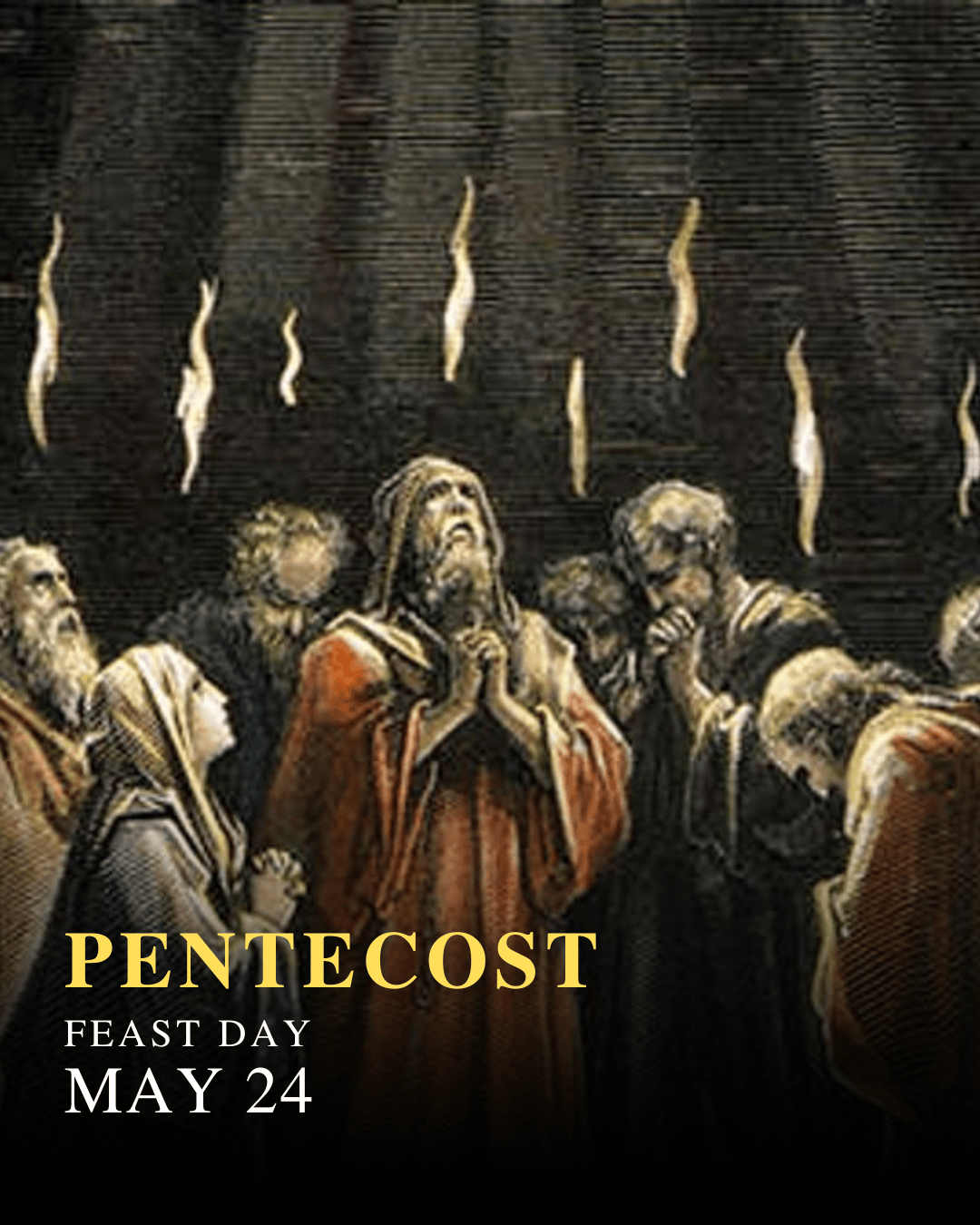
Pentecost is one of the most important celebrations in the Catholic Church because it marks the coming of the Holy Spirit upon the apostles and is often called the birthday of the Church. It is celebrated fifty days after Easter, after the Resurrection and Ascension of Jesus. The apostles had seen the risen Lord, but they were still waiting for the gift He promised: the Holy Spirit who would strengthen them, guide them, and send them out in mission.
After Jesus ascended into heaven, the apostles gathered in prayer with Mary, the Mother of Jesus. This detail is deeply meaningful. Before the Church went out into the world to preach, the Church first waited in prayer. The apostles did not begin their mission by relying on their own courage, intelligence, or planning. They waited for God. They prayed together. They stayed close to Mary, who already knew what it meant to receive the Holy Spirit with trust and surrender.
Suddenly, a sound like a strong driving wind filled the house where they were gathered. Tongues as of fire appeared and came to rest on each of them. They were filled with the Holy Spirit and began to speak in different languages. People from many nations heard the Gospel in their own tongues. This miracle showed that the message of Christ was not meant for only one people or one place. It was meant for the whole world.
Pentecost is not simply a dramatic event from the past. It is the beginning of the Church’s public mission and a reminder that the Holy Spirit is still active today. The same Spirit who strengthened the apostles continues to guide, sanctify, and renew the Church. You can also explore Mary’s role in this moment on our Mary, Queen of Apostles page.
Pentecost is often called the birth of the Church because it was the moment when the apostles moved from waiting in fear to proclaiming Christ with courage. Before Pentecost, the disciples were gathered behind closed doors. They had already encountered the risen Jesus, but they still needed the power of the Holy Spirit to begin the mission He entrusted to them. Pentecost changed everything.
St. Peter is one of the clearest examples of this transformation. Before the Crucifixion, Peter denied Jesus three times. He loved the Lord, but fear overcame him. At Pentecost, that same Peter stood before the crowd and boldly proclaimed the truth about Jesus. His courage did not come from self-confidence alone. It came from grace. The Holy Spirit strengthened him to become the shepherd and witness Christ had called him to be.
This is why Pentecost matters so much for ordinary Catholics. The apostles were not perfect people. They misunderstood Jesus at times. They argued. They were afraid. They failed. Yet the Holy Spirit did not abandon them. God worked through them anyway. Pentecost reminds us that weakness does not disqualify us from mission. When we open ourselves to the Holy Spirit, God can use our lives in ways we could never accomplish alone.
The Church was not born from human strategy or worldly power. It was born from the Spirit. It began with prayer, fire, courage, and proclamation. This same truth remains important today. The Church still needs the Holy Spirit more than programs, popularity, or perfect plans. Every parish, family, ministry, and Catholic home needs the breath of God to remain alive in faith.
Wisdom helps us see life from God’s perspective. It teaches us to value eternal things more than passing things and to choose what brings us closer to Him.
Understanding deepens our grasp of the faith. It helps us see the meaning behind what the Church teaches and recognize how God is working in our lives.
Counsel guides us in making good decisions. It helps us choose what is right, especially when life feels confusing or when we need moral clarity.
Fortitude gives courage to live and defend our faith. It strengthens us during trials, temptations, suffering, and moments when following Christ feels difficult.
Knowledge helps us recognize God’s presence in creation, in truth, and in daily life. It helps us understand what leads us toward God and what leads us away from Him.
Piety draws us into a loving relationship with God as Father. It helps prayer become more than duty and teaches us to love God with tenderness and trust.
Fear of the Lord inspires reverence and awe before God. It is not terror, but a holy awareness of His greatness and a desire not to be separated from Him.
Pentecost is not only something Catholics remember once a year. It is a mystery that speaks to daily life. Many people carry fear, discouragement, uncertainty, spiritual dryness, or a sense of not knowing what God wants next. Pentecost reminds us that God does not ask us to live the Christian life by our own strength. He gives the Holy Spirit to teach, guide, console, correct, and strengthen us.
The Holy Spirit helps us pray when we do not know what to say. He gives courage when we feel weak. He convicts us when we need to repent. He comforts us when grief feels heavy. He strengthens us to forgive, to begin again, to speak truth with love, and to keep going when faith feels difficult. Without the Holy Spirit, Christian life becomes exhausting. With the Holy Spirit, even ordinary life can become full of grace.
Pentecost also reminds us that faith is not meant to remain private in the sense of being hidden away. The apostles were sent out to proclaim Christ. Not everyone is called to preach publicly, but every Catholic is called to witness. A mother teaching her child to pray, a friend offering encouragement, a woman choosing patience instead of anger, a person forgiving after deep hurt, and a family making time for Sunday Mass are all ways the Gospel becomes visible.
For Catholic women, Pentecost can be especially encouraging because it reminds us that mission begins in prayer and can be lived in many hidden ways. The Holy Spirit works in homes, workplaces, friendships, parishes, and quiet sacrifices. He can make our ordinary words and actions fruitful when they are offered to God.
Mary’s presence at Pentecost is one of the most beautiful parts of this event. She had already lived a life completely open to the Holy Spirit. At the Annunciation, she said yes to God and conceived Jesus by the power of the Holy Spirit. At Pentecost, she was present as the apostles received the same Spirit for the mission of the Church. In a quiet but powerful way, Mary stands at both moments: the coming of Christ into the world and the sending of the Church into the world.
Mary teaches us how to wait for God. She does not rush ahead in anxiety. She does not demand every detail before she trusts. She listens, ponders, prays, and remains faithful. This is why she is such a strong guide for anyone preparing for Pentecost. She shows us that openness to the Holy Spirit begins with humility.
When we think of Pentecost, we often think of fire, wind, languages, and bold preaching. Those are important. But before the fire came, there was prayer. Before the preaching came, there was waiting. Before the apostles went out, they gathered with Mary. This reminds us that the most fruitful mission begins not with noise, but with surrender.
If you are in a season of waiting, Mary can help you remain faithful. If you are asking God for direction, she can help you pray with trust. If you are afraid to take the next step, she can help you receive the courage of the Holy Spirit. Her presence at Pentecost reminds us that the Church is never motherless.
The Holy Spirit does not only give dramatic gifts. He also works quietly and deeply in the soul. Sometimes His work looks like a sudden courage we did not have before. Other times it looks like slow healing, growing patience, a softer heart, a clearer conscience, or a stronger desire for prayer. Pentecost reminds us to pay attention to the ways God may already be working within us.
The apostles were changed from the inside out. Their circumstances did not suddenly become easy. In fact, their mission brought suffering, rejection, and sacrifice. But they were no longer alone. The Holy Spirit gave them strength that did not depend on comfort. This is important for us too. The Spirit does not always remove every difficulty, but He gives grace to live faithfully within it.
The Holy Spirit also brings unity. At Pentecost, people from many nations heard the Gospel in their own languages. This was a sign that the Church is universal. Sin divides, but the Spirit gathers. Pride isolates, but the Spirit creates communion. In families, friendships, and communities, we can ask the Holy Spirit to heal division and teach us how to love with humility.
When we invite the Holy Spirit into our daily lives, we are asking God to form us into people who reflect Christ more clearly. This is not always comfortable, because growth often requires surrender. But it is always good. The Spirit leads us toward truth, holiness, freedom, and love.
Pentecost can be celebrated in simple but meaningful ways. Begin by attending Mass with a heart open to the Holy Spirit. Listen closely to the readings and ask God to renew the grace of your Baptism and Confirmation. Pentecost is a good day to pray intentionally for courage, wisdom, and a deeper love for the Church.
Families can talk about the gifts of the Holy Spirit and what they look like in everyday life. Wisdom may look like choosing what is holy over what is popular. Fortitude may look like doing the right thing when it is hard. Counsel may look like asking God for guidance before making a decision. Piety may look like praying with love instead of rushing through prayer.
You can also pray a simple prayer such as “Come, Holy Spirit” throughout the day. This short prayer is powerful because it invites God into the present moment. Pray it before a conversation, before making a decision, before beginning work, when you feel anxious, or when you need patience.
Pentecost is also a good time to renew your commitment to sharing Christ. This does not have to be complicated. You might invite someone to Mass, share a faith-filled reflection, encourage a friend, pray for someone who is struggling, or simply live your faith more openly and joyfully. The Holy Spirit can use small acts of faith in ways we may never fully see.
Pentecost reminds us that we are not meant to live our faith alone. The Holy Spirit strengthens, guides, and transforms us. Like the apostles, we are called to step out with courage and share the love of Christ. The Christian life is not only about believing privately; it is about allowing God to transform us so that our lives become a witness to His goodness.
The same Spirit given at Pentecost is alive in the Church today, especially through the sacraments. In Baptism, we receive new life in Christ. In Confirmation, we are strengthened by the Holy Spirit for witness and mission. In the Eucharist, we are united to Jesus and nourished for the journey. The sacraments are not empty rituals. They are encounters with God’s grace.
Pentecost also teaches us that courage is a gift. The apostles did not manufacture holiness by effort alone. They received. This matters because many people feel discouraged when they see their own weakness. Pentecost says: bring your weakness to God. Ask for the Spirit. Let Him strengthen what is fragile, heal what is wounded, and awaken what has grown tired.
You may prepare your heart through our Morning Prayer, Evening Prayer, and Healing Prayer pages. Pentecost invites us to be open to God, listen to His voice, and live with bold faith. It is a feast of renewal, mission, courage, and hope.
“Come, Holy Spirit, fill my heart and guide me in truth and love.”
— Traditional prayer