Mary, Queen of Apostles
Mother of the Church and Guide of Mission
New Testament Era
Mother of the Church and Guide of Mission
New Testament Era
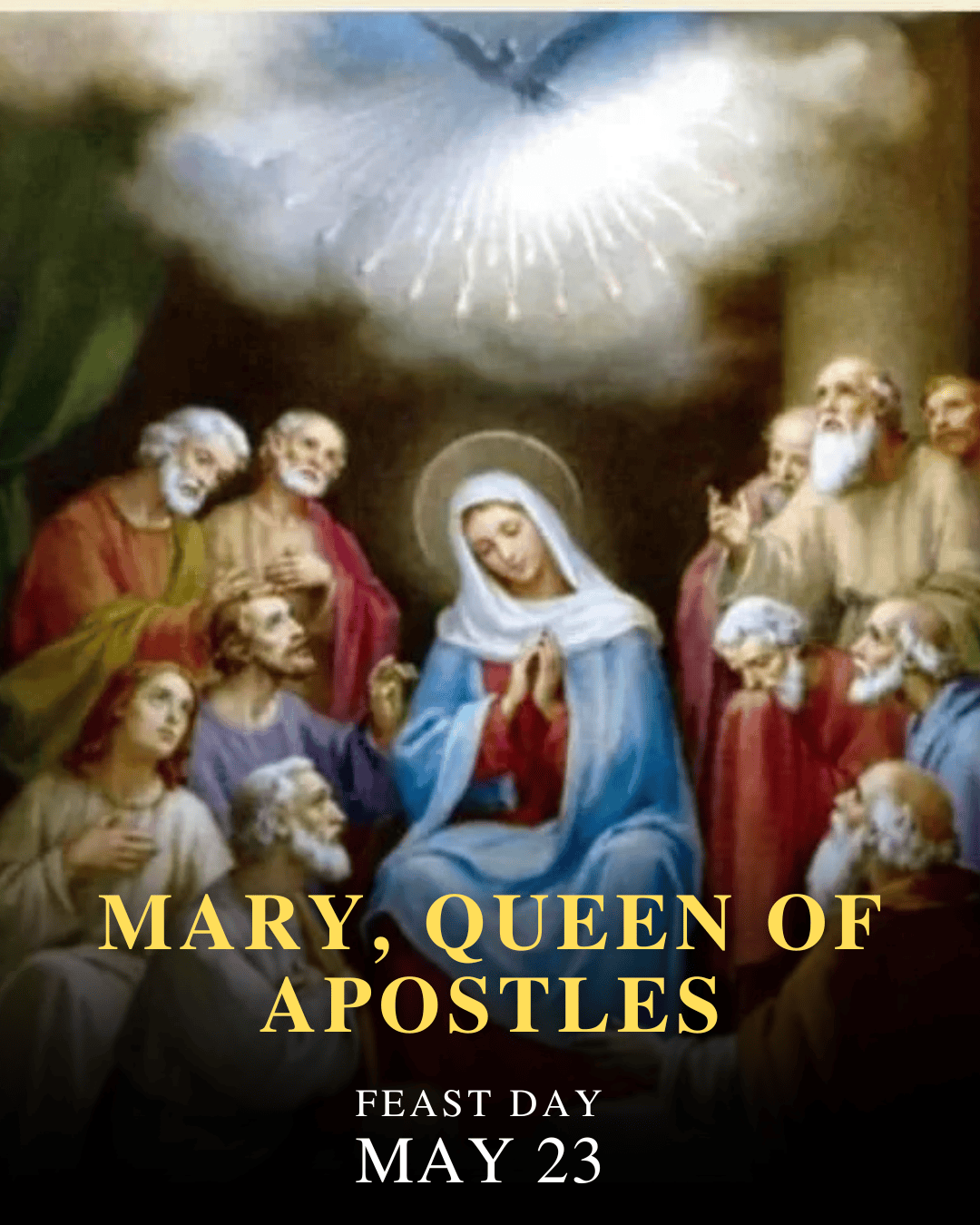
Mary, Queen of Apostles, is a beautiful title given to the Blessed Virgin Mary because of her unique place in the life of Jesus, the apostles, and the early Church. She was not one of the Twelve Apostles, yet no one followed Christ more perfectly than she did. From the Annunciation to Calvary, from the empty tomb to Pentecost, Mary remained faithful. She listened, believed, pondered, suffered, waited, and loved. Her life shows that the mission of the Church begins not with activity alone, but with a heart surrendered to God.
After the Ascension of Jesus, the apostles entered a time of waiting. They had seen the risen Lord. They had received His promise that the Holy Spirit would come. But they were still human. They had known fear, confusion, weakness, and failure. Into that upper room, Mary brought the steady presence of a mother. She had already lived the deepest yes to God. She had already trusted Him through mystery, poverty, danger, sorrow, and the Cross. Her presence among the apostles was not decorative. It was maternal, spiritual, and deeply important.
Mary is called Queen of Apostles because she supported the apostolic mission from its very beginning. She prayed with the apostles as they waited for Pentecost. She encouraged them by her faith. She reminded them, simply by her presence, that Jesus was worth everything. Before the apostles preached to the nations, they first waited in prayer with Mary. This shows something very important: Christian mission must be born from prayer, not from pride or restlessness.
Today, this title reminds Catholics that Mary continues to guide the Church toward Jesus. She does not replace Christ. She leads us to Him. She does not take attention away from the Gospel. She teaches us how to receive it, live it, and share it. As Queen of Apostles, Mary helps every Christian remember that we are all called to participate in the mission of Christ, each according to our vocation and state in life.
One of the most meaningful images of Mary as Queen of Apostles is Mary in the upper room after the Ascension. The apostles were gathered in prayer, waiting for the coming of the Holy Spirit. This moment was quiet, hidden, and full of expectation. It was not yet the public preaching of Pentecost. It was the preparation before the mission. Mary was there, praying with them.
This matters because Mary had already experienced the overshadowing of the Holy Spirit at the Annunciation. She knew what it meant to receive God’s promise before understanding every detail. She knew what it meant to say yes before seeing the full road ahead. In the upper room, she stood as a mother and model for the apostles, teaching them by example how to wait in faith.
Many people struggle with seasons of waiting. Waiting for clarity, healing, reconciliation, direction, conversion, peace, or courage can be difficult. Mary’s presence in the upper room speaks directly to that experience. She reminds us that waiting with God is not wasted time. It can be a sacred time of preparation. Before God sends us, He often forms us. Before He asks us to speak, He teaches us to listen. Before the Church went out to the world, the Church prayed with Mary.
For Catholic women today, this image can be deeply comforting. There are seasons when life feels like an upper room: uncertain, prayerful, hidden, and waiting for the next step. Mary teaches us to remain faithful there. She teaches us not to rush ahead of grace, not to panic in silence, and not to mistake hidden preparation for abandonment.
Mary trusted God completely, even when she did not know every detail of the path ahead. She teaches us to say yes to God with a faithful heart and to believe that His plan is good.
Mary prayed with the apostles before Pentecost. She reminds us that mission begins in prayer and that every important work for God must be rooted in Him first.
Mary guided quietly, not through force or self-promotion, but through humility, wisdom, and love. She shows us that true spiritual leadership serves others and points them to Christ.
Mary waited in faith for the coming of the Holy Spirit. She encourages us to rely on God’s timing, guidance, and strength instead of depending only on our own plans.
Mary is called Queen of Apostles because she has a special relationship to the apostolic mission of the Church. The apostles were chosen by Christ to preach the Gospel, build up the Church, and witness to the Resurrection. Mary, as the Mother of Jesus and the Mother of the Church, supported that mission in a unique way. Her motherhood did not end at Bethlehem or Calvary. It continued in the life of the Church.
At the Cross, Jesus entrusted Mary to the beloved disciple and the beloved disciple to Mary. Catholics have long understood this moment as deeply meaningful for the whole Church. Mary becomes a spiritual mother to the disciples of Christ. As Mother of the Church, she cares for those who follow her Son. As Queen of Apostles, she especially encourages the Church’s mission to share the Gospel.
Her queenship is not about worldly power. Mary’s queenship is rooted in humility, holiness, and her closeness to Christ the King. She reigns as a mother, not as a distant ruler. She leads by intercession, example, and love. This is why Catholic devotion to Mary always leads back to Jesus. Her greatness is inseparable from Him.
The title Queen of Apostles also reminds us that every mission needs Mary’s kind of faith. The apostles needed courage, but they also needed prayer. They needed preaching, but they also needed the Holy Spirit. They needed boldness, but they also needed humility. Mary embodies these virtues. She shows the Church how to be both contemplative and missionary.
The mission of the Church is to bring Christ to the world. Mary did this first in the most literal and beautiful way: she carried Jesus in her womb and brought Him into the world. In this sense, every Christian mission has a Marian pattern. We receive Christ, allow Him to dwell within us, and then bring His love to others through our words, actions, service, and witness.
Mary’s mission was not loud, but it was powerful. She lived with a heart fully open to God. She noticed needs, as she did at the wedding feast of Cana. She interceded. She listened. She treasured God’s word. She stood at the Cross when others fled. She prayed with the apostles when the Church was waiting to be strengthened. Her mission was faithful presence, and that presence bore lasting fruit.
This is encouraging for anyone who feels that their own mission is small. Not everyone is called to preach publicly, teach formally, or lead a visible ministry. Some are called to evangelize through motherhood, friendship, caregiving, hospitality, writing, encouragement, prayer, or quiet sacrifice. Mary reminds us that hidden faithfulness can still be deeply apostolic when it brings Christ to others.
The Church needs both action and contemplation. It needs people who serve, teach, evangelize, and build. But it also needs souls who pray, listen, intercede, and remain close to Jesus. Mary holds these together perfectly. She is prayerful and missionary, humble and strong, silent and fruitful.
Mary, Queen of Apostles, offers a powerful example for Catholic women because she shows that spiritual influence does not have to be loud to be real. Many women guide families, friendships, ministries, and communities through quiet faith. They pray when no one sees. They encourage when others are discouraged. They keep showing up when life feels uncertain. Mary honors that kind of hidden strength.
Her life teaches that prayer is not an escape from mission. Prayer is the foundation of mission. Before we speak about God, we need to speak with God. Before we serve others, we need to receive from Him. Before we try to fix everything, we need to sit with the Lord and ask for His wisdom. Mary’s presence in the upper room reminds us that the Holy Spirit is not an optional extra. He is the source of courage, clarity, and fruitfulness.
Mary also teaches women to lead through love rather than pressure. Her leadership is maternal. She does not dominate. She nurtures. She does not seek attention. She points to Christ. At Cana, her words were simple: “Do whatever he tells you.” That remains the heart of Marian guidance. She helps us listen to Jesus and obey Him with trust.
In a world that often measures worth by visibility, Mary reminds us that God sees the hidden yes. He sees the mother praying over her children, the woman returning to faith after a hard season, the friend comforting someone in pain, the worker choosing integrity, and the person quietly trying to follow Christ. These hidden acts can become part of the Church’s mission.
One lesson from Mary is that mission begins with surrender. At the Annunciation, Mary gave her yes to God before she knew everything that would follow. That yes shaped her whole life. The apostles also had to learn surrender. They had to let go of fear, personal ambition, confusion, and self-reliance. Mary’s presence helped form them in trust.
Another lesson is that prayer prepares us for courage. The apostles did not become bold because they forced themselves to be brave. They received the Holy Spirit. Mary teaches us to ask, wait, and receive. Courage that comes from God is different from mere confidence. It is rooted in grace.
Mary also teaches that spiritual motherhood matters. Whether a woman is a biological mother or not, she can still have a motherly heart that nurtures faith in others. Spiritual motherhood can be lived through prayer, encouragement, teaching, service, hospitality, mentoring, and compassion. Mary shows that a mother’s heart can help strengthen the Church.
Finally, Mary teaches that mission should always lead people to Jesus, not to ourselves. She never makes herself the center. Her life is a living invitation to know, love, and follow Christ. This is the heart of every true apostolic mission. We are not called to build our own glory. We are called to help others encounter Him.
A simple way to grow in devotion to Mary, Queen of Apostles, is to ask her to help you become more faithful to your own mission. This does not have to be complicated. You can begin with a short prayer in the morning: “Mary, Queen of Apostles, help me bring Jesus to the people I meet today.” This small prayer can shape the way you speak, serve, listen, and respond throughout the day.
You can also meditate on the mysteries of the Rosary, especially the Annunciation, the Visitation, the Crucifixion, and Pentecost. These moments reveal Mary as a woman of surrender, service, suffering, prayer, and mission. The Rosary is not only a devotion of repetition. It is a way of walking through the life of Christ with Mary.
Another helpful practice is to invite Mary into your moments of waiting. If you are waiting for clarity, healing, direction, conversion, or courage, ask her to pray with you as she prayed with the apostles. She understands waiting with faith. She knows how to remain steady when God’s plan unfolds slowly.
You may also grow in prayer through our Morning Prayer, Evening Prayer, and Healing Prayer pages. If you are interested in other Marian devotions, you may also enjoy reading about Our Lady of Fatima and St. Louis de Montfort.
Mary, Queen of Apostles, reminds us that we are all called to share the Gospel in some way. This does not always mean preaching from a stage or leading a public ministry. It means allowing Christ to live in us so that our lives become a witness to His love. Mary’s life shows that mission flows from a deep relationship with God.
Like Our Lady of Fatima and St. Louis de Montfort, Mary leads us closer to Jesus. Her presence among the apostles teaches us that we are not alone in our faith journey. The Church is a family, strengthened by prayer, guided by the Holy Spirit, and watched over by a loving mother.
This title also reminds us that the Church’s mission is not sustained by human effort alone. The apostles needed the Holy Spirit. We need Him too. Mary helps us wait, pray, and receive. She teaches us to trust God’s timing instead of rushing ahead in anxiety.
Mary invites us to remain faithful, to pray deeply, and to share Christ’s love with the world. As Queen of Apostles, she encourages every believer to live with courage, humility, and a heart open to the Holy Spirit.
“Mary, Queen of Apostles, guide me to follow Christ and share His love.”
— Traditional devotion inspired prayer