Visitation of the Blessed Virgin Mary
A Meeting of Joy, Service, and Grace
New Testament Event
A Meeting of Joy, Service, and Grace
New Testament Event
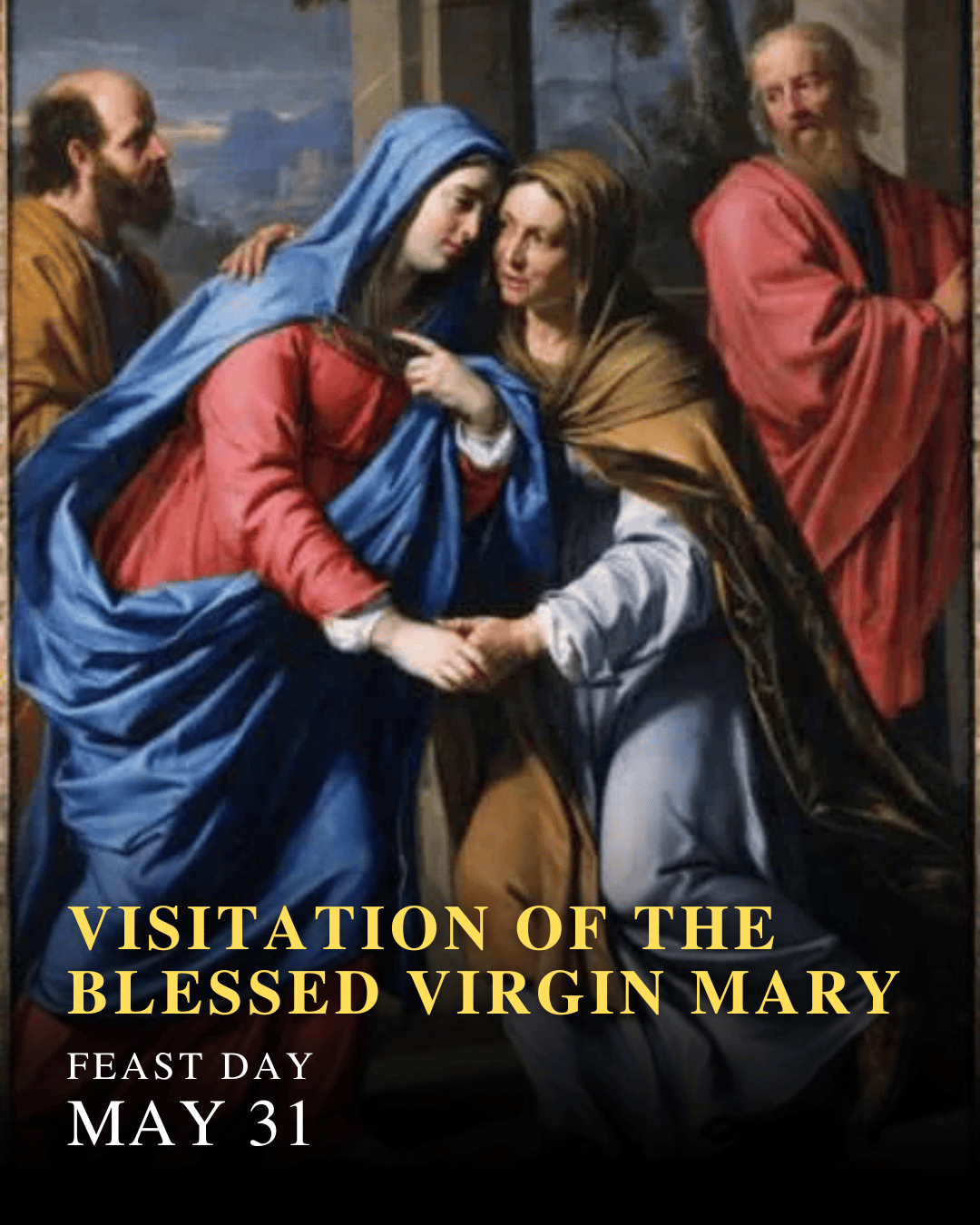
The Visitation of the Blessed Virgin Mary is the moment when Mary traveled to visit her cousin Elizabeth after the Annunciation. The angel Gabriel had told Mary that she would become the Mother of Jesus, and he also revealed that Elizabeth, though advanced in age, had conceived a child. Mary had just received the most astonishing news in human history, yet she did not turn inward or think only of herself. She went in haste to serve.
This feast is full of tenderness, joy, humility, and grace. Mary carried Jesus in her womb, and when she entered Elizabeth’s home, the presence of Christ brought joy before He was even born. John the Baptist, still in Elizabeth’s womb, leapt for joy. Elizabeth, filled with the Holy Spirit, recognized Mary as the Mother of the Lord. Mary then proclaimed the Magnificat, a prayer of praise that reveals her humble and grateful heart.
The Visitation shows us what happens when a soul says yes to God and then brings Christ to others. Mary does not keep grace to herself. She carries Christ into another home, another family, another need. In this simple and beautiful event, the Church sees a model of Christian service, joyful faith, and love that moves quickly toward others.
One of the most meaningful details of the Visitation is that Mary went “in haste.” This does not mean she was restless, anxious, or careless. It means her love was active. After receiving God’s word through the angel, Mary responded not only with belief but with movement. She allowed grace to become service. She knew Elizabeth had been blessed with a child in her old age, and Mary went to be with her.
This detail can speak deeply to Catholic women today. Sometimes faith remains only in thought or feeling. We believe, we pray, and we reflect, but we hesitate when love asks us to act. Mary shows us that true faith becomes generous. It notices the needs of others. It does not wait for the perfect moment or the easiest conditions. When love is rooted in God, it becomes ready to serve.
Mary’s haste was also humble. She had just been chosen to become the Mother of God, yet she did not demand attention, comfort, or admiration. She went to help Elizabeth. This is one of the quiet wonders of Mary’s life. The more God exalts her, the more humbly she serves. She does not use her vocation to separate herself from others. She allows her vocation to make her more available to them.
In ordinary life, this may look like checking on someone who is struggling, bringing a meal, visiting a lonely person, praying with a friend, helping a family member, or simply being present when someone needs comfort. The Visitation reminds us that holiness often travels through ordinary acts of care. Mary’s visit was not a public performance. It was a hidden act of love, and yet the Church celebrates it as a feast of grace.
Mary went to help Elizabeth. She teaches us that love is not passive. When God fills a heart with grace, that grace naturally reaches outward. Service does not always have to be dramatic. Often it begins with noticing who needs encouragement, presence, help, or prayer.
The meeting between Mary and Elizabeth was filled with joy because Christ was present. The Visitation reminds us that true Christian joy is not based on perfect circumstances. It comes from the presence of God and the recognition that He is at work.
Mary praised God, not herself. Even when Elizabeth blessed her, Mary turned the attention back to the Lord. Her humility teaches us to receive blessings gratefully without becoming prideful or self-focused.
Mary trusted God’s promise even before she could see how everything would unfold. Elizabeth praised her because she believed. This faith encourages us to trust God even when His plan is still hidden.
When Mary entered Elizabeth’s home, something beautiful happened. Elizabeth was filled with the Holy Spirit and cried out, “Blessed are you among women, and blessed is the fruit of your womb.” She recognized that Mary was not simply visiting as a relative. Mary was coming as the Mother of the Lord, carrying Jesus within her.
This moment reveals the work of the Holy Spirit. Elizabeth did not discover this truth by ordinary observation. She received it as grace. Her words became part of the prayer Catholics still say in the Hail Mary: “Blessed are you among women, and blessed is the fruit of your womb, Jesus.” Every time Catholics pray the Hail Mary, they echo Elizabeth’s Spirit-filled greeting.
Elizabeth’s response also teaches us how to receive holy people and holy moments with reverence. She does not respond with jealousy. She does not compare her blessing to Mary’s blessing. Instead, she rejoices. She honors what God is doing in Mary. This is a powerful lesson in a world where comparison can quietly steal joy.
Sometimes another person’s blessing can make us feel overlooked. Elizabeth shows another way. She rejoices in Mary’s vocation while also recognizing God’s work in her own life. Both women are blessed. Both children have a mission. Both stories belong to God. The Visitation invites us to celebrate grace wherever it appears, even when it appears in someone else’s life.
One of the most tender parts of the Visitation is that John the Baptist leapt in Elizabeth’s womb when Mary greeted her. Before John could preach, baptize, or point to Jesus at the Jordan River, he already responded to the presence of Christ. His joy began before birth. This detail reminds us of the mystery and dignity of life in the womb, and it also reveals the deep spiritual connection between Jesus and John.
John’s leap of joy shows that Christ’s presence changes the atmosphere of a home. Mary did not arrive with worldly riches or public recognition. She arrived carrying Jesus. That was enough to bring joy. This can be a beautiful meditation for family life. What matters most in a home is not perfection, wealth, appearance, or control. What matters most is whether Christ is welcomed there.
Catholic homes do not have to be flawless to be holy. They can be noisy, tired, imperfect, and still filled with grace. A home where prayer is attempted, forgiveness is practiced, meals are shared, and Christ is remembered can become a place of visitation. Mary’s visit to Elizabeth reminds us that Jesus can enter ordinary rooms and make them holy.
John’s joy also invites us to ask whether we recognize Christ when He comes quietly. God does not always arrive in dramatic ways. Sometimes He comes through a visit, a conversation, a prayer, a child, a moment of service, or a word of encouragement. The Visitation trains the heart to become attentive to grace.
In response to Elizabeth’s greeting, Mary proclaims the Magnificat: “My soul magnifies the Lord, and my spirit rejoices in God my Savior.” This prayer is one of the most beautiful songs of praise in Scripture. It reveals Mary’s heart as humble, grateful, courageous, and completely centered on God.
Mary does not magnify herself. She magnifies the Lord. She recognizes that God has looked upon her lowliness and done great things for her. Her prayer teaches us how to receive blessings without pride. Everything good in her life is received as gift. She knows that God is the source of her vocation, her joy, and her strength.
The Magnificat is also a prayer of holy reversal. Mary praises God who lifts up the lowly, fills the hungry, remembers His mercy, and casts down the proud. This is not a shallow or sentimental prayer. It is a strong prayer that reveals God’s justice and mercy. Mary sees history through God’s eyes. She knows that the powerful do not have the final word. God does.
For women today, the Magnificat can become a daily prayer of trust. When life feels uncertain, Mary teaches us to praise. When we feel small, Mary reminds us that God sees the lowly. When we feel hungry for hope, healing, or direction, Mary points us to the God who fills the hungry with good things.
The Visitation reminds us that every Christian is called to bring Christ to others. Mary does this in the most literal way, carrying Jesus in her womb. But by grace, we are also called to carry Christ into the world. Through baptism, prayer, the Eucharist, and the life of grace, Christ dwells in us. Our words, presence, kindness, and service can become ways He reaches others.
This is especially meaningful in daily family life. A mother can bring Christ to her children through patience and prayer. A wife can bring Christ into her marriage through forgiveness, honesty, and love. A friend can bring Christ through encouragement. A woman in the workplace can bring Christ through integrity and compassion. A parish volunteer can bring Christ through humble service that no one applauds.
We do not need to be perfect before God can use us. Mary is sinless, but her example does not push us away. It draws us closer. She shows what a surrendered life looks like. She teaches us that the more deeply we receive Christ, the more naturally we can bring Him to others.
This is not about forcing faith into every conversation. It is about becoming a person through whom Christ’s love is visible. Sometimes bringing Christ means speaking clearly about the faith. Other times it means listening patiently, forgiving sincerely, serving quietly, or praying faithfully for someone who may never know.
The Visitation is a deeply feminine and deeply powerful Gospel moment. It is a meeting between two women, both carrying miraculous life, both living within God’s plan, both responding with faith. Mary and Elizabeth show the beauty of holy friendship, spiritual encouragement, and shared joy. Their meeting is not competitive. It is communion.
This matters because many women carry hidden burdens. Some are caring for children, aging parents, spouses, homes, parishes, or communities. Some are carrying grief, infertility, loneliness, anxiety, or uncertainty. Some are learning to trust God through a season that does not make sense. The Visitation shows that women need holy companionship. Elizabeth’s home becomes a place where faith is recognized and joy is shared.
Mary also teaches that being chosen by God does not remove the call to serve. Sometimes people imagine holiness as something separate from ordinary responsibility. Mary shows the opposite. She receives the greatest vocation ever given to a human person, and then she goes to help. Grace makes her more loving, not less available.
The Visitation invites Catholic women to ask: Who is my Elizabeth? Who needs my presence, encouragement, prayer, or practical help? It also invites another question: Who helps me recognize God’s work in my life? We need both humility to serve and humility to receive support.
To live the Visitation today, begin by carrying Christ intentionally. This means staying close to Him through prayer, confession, Mass, Scripture, and the quiet offering of daily duties. We cannot bring what we refuse to receive. Mary brought Christ because she had first welcomed Him with her yes.
Another way is to practice attentive service. Ask God to show you one person who needs encouragement this week. It may be a relative, a friend, a neighbor, someone in your parish, or someone in your online community. A message, a prayer, a visit, or a simple act of help can become a small visitation of grace.
You can also pray the Magnificat slowly. Let Mary’s words teach your heart how to praise God. Her prayer can be especially powerful when you feel forgotten, small, or uncertain. The Magnificat reminds us that God sees the lowly, remembers His mercy, and works in hidden ways.
Finally, live with holy joy. Christian joy does not deny suffering. Mary’s life would include the Cross. Elizabeth’s son would become a prophet and martyr. Yet in this moment, both women rejoice because God is faithful. The Visitation teaches us to notice grace even when life is unfinished, imperfect, or difficult.
The Visitation reminds us that we are called to bring Christ to others. Like Mary, we carry God’s presence into our homes, relationships, workplaces, parishes, and daily lives. Every act of Christian love can become a way of making Christ known.
This event also shows the beauty of community. Faith is strengthened when it is shared. Mary and Elizabeth encourage each other, rejoice together, and recognize God’s work. Their meeting reminds us that holy friendship can help us see grace more clearly.
The Visitation invites us to respond to God with gratitude, just as Mary did in the Magnificat. Instead of focusing only on fear or uncertainty, Mary praises God for His mercy. Her prayer teaches us that thanksgiving is a powerful response to grace.
You can also reflect on Mary’s role in our Mary, Mother of the Church page. Her spiritual motherhood helps us understand why she continues to guide the Church toward Christ.
You may deepen your prayer life through our Morning Prayer and Evening Prayer pages. A steady habit of prayer can help you become more attentive to God’s voice and more generous in serving others.
The Visitation calls us to live with love, to serve with joy, and to trust in God’s work in our lives. Mary’s example reminds us that grace is never meant to stop with us. When Christ dwells in our hearts, we are sent to carry His love into the world.
“Lord, help me to bring Your love and presence to others.”
— Inspired by the Magnificat