St. Joan of Arc
Warrior of Faith and Courage
1412–1431
Warrior of Faith and Courage
1412–1431
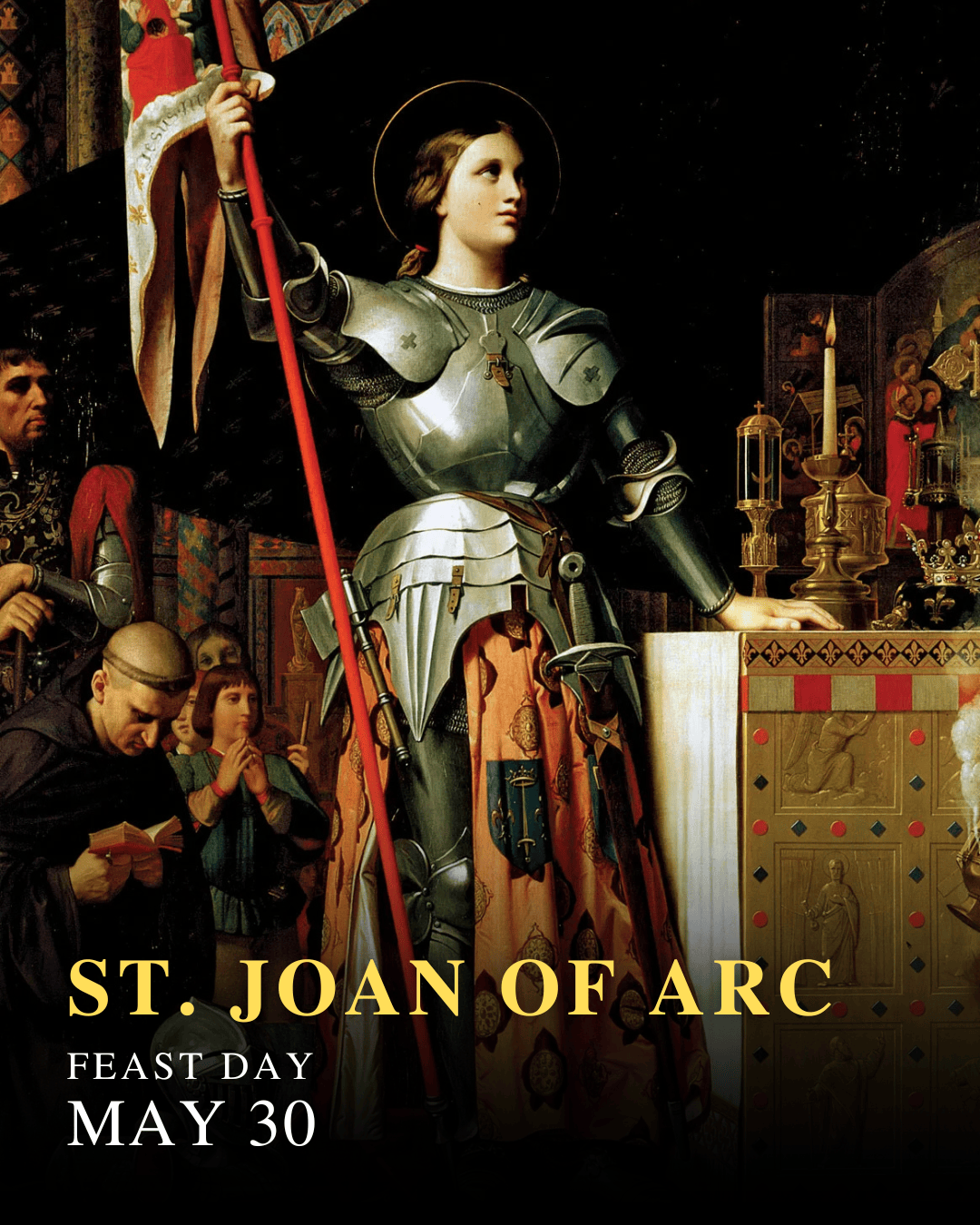
St. Joan of Arc was a young French girl who became one of the most unforgettable saints in Catholic history. She was born around 1412 in Domrémy, a small village in France, during the long and painful conflict known as the Hundred Years’ War. Her family was simple and faithful, and Joan grew up in a rural home where prayer, work, and trust in God shaped everyday life. She was not born into power, wealth, or influence. She was an ordinary village girl, yet God called her to an extraordinary mission.
When Joan was still young, she began to believe that God was asking something of her. She heard heavenly voices, which she identified as St. Michael the Archangel, St. Catherine, and St. Margaret. These voices urged her to remain faithful, live purely, and help France in a time of crisis. For many people, her mission seemed impossible. She was young, poor, female, and without military training. But Joan believed that when God gives a mission, He also gives the grace needed to obey.
St. Joan of Arc became a sign of courage, purity, obedience, and trust. She helped inspire French forces, encouraged the rightful king, and brought hope to people who had suffered deeply. Yet her life was also marked by betrayal, imprisonment, trial, and martyrdom. She died at only nineteen years old, but her witness has continued to strengthen Catholics for centuries.
One of the most striking things about St. Joan of Arc is her youth. She was not a scholar, noblewoman, or trained leader. She was a teenage girl from a small village, and yet she trusted that God could work through her life. This is part of what makes her story so powerful. Her holiness does not begin with worldly qualifications. It begins with listening to God and responding with faith.
Joan’s life reminds us that God does not only call people who feel ready. He often calls people who feel too small, too young, too inexperienced, or too ordinary. In Scripture, God calls shepherds, fishermen, widows, children, and sinners. St. Joan belongs to that same pattern of grace. Her life tells us that the question is not, “Am I impressive enough for God to use me?” The better question is, “Am I willing to say yes?”
Her yes was not easy. She had to leave the comfort of her home, speak to powerful men, face suspicion, and carry a mission that many people could not understand. She did not obey God because the path was clear and comfortable. She obeyed because she trusted the One who called her. That kind of trust is deeply needed in ordinary Catholic life. Many women today are asked to be faithful in hidden, difficult, or misunderstood ways. St. Joan shows that obedience to God can be costly, but it is never wasted.
For a woman trying to follow Christ today, Joan’s story can be both challenging and comforting. She challenges us to stop making fear the final voice in our decisions. She comforts us by showing that God sees the hidden soul, the small village, the quiet prayer, and the young heart that wants to serve Him. Holiness does not require a perfect background. It requires a faithful response.
St. Joan followed God’s call even when the mission seemed frightening and impossible. Her courage was not simply natural boldness. It came from faith. She teaches us that true courage is not the absence of fear, but the decision to obey God even when fear is present.
Joan believed that God was guiding her. She listened, prayed, and trusted. Her faith reminds us that God still speaks to the soul through prayer, conscience, Scripture, the Church, and the quiet movements of grace.
She followed the mission God gave her, even when it led to suffering. Her obedience was not blind stubbornness. It was rooted in love for God and confidence that His will mattered more than human approval.
St. Joan valued purity of heart, body, and intention. She reminds us that purity is not weakness or naivety. It is strength ordered toward God, a freedom that helps the soul belong more fully to Him.
Joan remained faithful through accusation, imprisonment, fear, and suffering. She shows us how to keep choosing God when life becomes difficult, lonely, or misunderstood.
St. Joan of Arc lived during a time when France was wounded by war and division. Many people had lost hope. Political conflict, military defeat, and uncertainty weighed heavily on the country. Into this suffering stepped a young woman who did not have the kind of power the world usually respects. She did not come with wealth, status, or military education. She came with conviction, faith, and a belief that God had called her.
Her courage was not about loving violence. Joan was not a saint because she enjoyed battle. She was a saint because she sought to obey God faithfully in the circumstances of her time. She encouraged purity among soldiers, urged confession, and wanted those around her to honor God. Her presence was not only military; it was spiritual. She reminded men hardened by war that they still stood before God.
This is important to remember because St. Joan’s courage was deeply connected to holiness. She was not simply brave in a worldly sense. She was brave because she belonged to God. She did not trust herself as the source of victory. She trusted God. She did not make herself the center of the story. She saw herself as a servant of a mission.
In everyday life, most of us are not called to a battlefield like Joan. But we do face spiritual battles. We face discouragement, temptation, family struggles, cultural confusion, fear of rejection, and pressure to stay silent about our faith. St. Joan teaches us that courage begins in the soul. A courageous Catholic woman is not one who never feels weak. She is one who keeps turning back to God and choosing what is right.
After helping bring hope to France, Joan was captured and eventually placed on trial. Her trial was painful and unjust. She was questioned, pressured, and treated with suspicion. Powerful people tried to trap her words and undermine her mission. She was young and alone in many ways, but she remained remarkably strong.
Joan’s suffering reveals a different kind of courage from the courage seen on the battlefield. It is one thing to be brave when others are cheering. It is another thing to remain faithful when you are isolated, accused, and afraid. During her trial, Joan had to cling to God when human support was limited. Her strength came not from comfort, but from conviction.
She was condemned and burned at the stake in 1431 at about nineteen years old. Her death is heartbreaking, but it is not the end of her story. Years later, her trial was reviewed, and she was cleared of the accusations against her. Eventually, the Church recognized her holiness, and she was canonized as a saint. Her life became a witness not only to courage, but also to the truth that God can vindicate His servants in His own time.
Her martyrdom speaks to anyone who has been misunderstood or judged unfairly. It reminds us that being faithful does not guarantee that others will understand us. Sometimes obedience to God will bring criticism. Sometimes doing the right thing will feel lonely. St. Joan helps us remember that our final hope is not in human approval, but in God’s judgment, mercy, and love.
St. Joan of Arc still matters because her life speaks to the fears many people carry today. She was young in a world controlled by older and more powerful people. She was a woman in a world that often dismissed women’s voices. She was faithful in a world filled with politics, violence, and confusion. She was misunderstood by many, yet she remained obedient to God.
Many Catholic women can relate to parts of her story, even if their lives look very different. A woman may feel too young to lead, too quiet to speak, too wounded to serve, or too ordinary to matter. Joan’s life pushes back against those fears. God does not measure a soul by worldly importance. He looks at love, faith, humility, and willingness.
Her example is also important for women who are trying to raise children or influence others in faith. Joan’s courage did not appear out of nowhere. She grew up in a world where faith was part of ordinary life. Prayer, the sacraments, reverence for God, and trust in the saints shaped her imagination. This is a reminder that the small Catholic habits in a home matter. A child who sees prayer, hears holy stories, and watches adults trust God may be strengthened in ways no one can measure immediately.
St. Joan also matters because she shows that holiness can be bold. Sometimes people mistake holiness for passivity. Joan was humble, but she was not passive. She was obedient, but she was not weak. She was pure, but she was not timid. Her holiness had strength. She reminds us that Christian womanhood is not about shrinking back from every challenge. It is about belonging to Christ so deeply that we can act with courage when He asks something of us.
One way to grow spiritually with St. Joan of Arc is to ask God for courage in the specific place where fear has been holding you back. That might mean having a difficult conversation, going back to confession, praying with your family, setting a boundary, speaking the truth kindly, or taking the next step in a calling that feels too big. Courage becomes real when it touches daily life.
Another way is to practice listening. Joan listened for God’s guidance. Catholics do not need to seek dramatic experiences in order to be faithful, but we do need quiet hearts. Prayer, Scripture, spiritual reading, the sacraments, and time before the Lord help us become more attentive to His will. In a noisy world, listening to God is a form of spiritual strength.
We can also learn from Joan’s purity of intention. She wanted to serve God, not build her own fame. This is a beautiful lesson for anyone involved in family life, ministry, online work, leadership, or service. It is easy to begin with good intentions and slowly become distracted by approval, recognition, or comparison. Joan reminds us to return often to the simple question: Is this for God?
Finally, her life invites us to persevere when we are misunderstood. Not every faithful choice will be praised. Not every sacrifice will be noticed. Not every prayer will feel powerful. But God sees. St. Joan’s life tells us that a soul can remain faithful even under pressure, and that God can bring fruit from obedience long after the world thinks the story is over.
St. Joan of Arc reminds us that God calls ordinary people to do extraordinary things. Her life shows that courage rooted in faith can change the world. She did not have the advantages that people usually associate with greatness, but she had trust in God. That trust made her strong.
Like St. Augustine of Canterbury and St. Philip Neri, she followed God’s call with trust and boldness. Like St. Catherine of Siena, she reminds us that young women can have a powerful spiritual influence when they are surrendered to God.
Her example encourages us to listen to God, to trust His plan, and to act with courage in daily life. Most of us will not be called to Joan’s exact mission, but every Catholic is called to holiness. Every Catholic is called to be faithful in the place where God has planted them.
You may also grow spiritually through our Morning Prayer and Evening Prayer pages. A steady rhythm of prayer can help you become more attentive to God’s voice and more courageous in following His will.
St. Joan invites us to be brave, to trust God fully, and to live our faith boldly. Her life asks each of us to consider where God may be calling us to greater courage, greater purity, greater obedience, and greater love.
“St. Joan of Arc, help me to be courageous and faithful to God’s call.”
— Prayer inspired by her life