St. Augustine of Canterbury
Missionary to England
d. 605
Missionary to England
d. 605
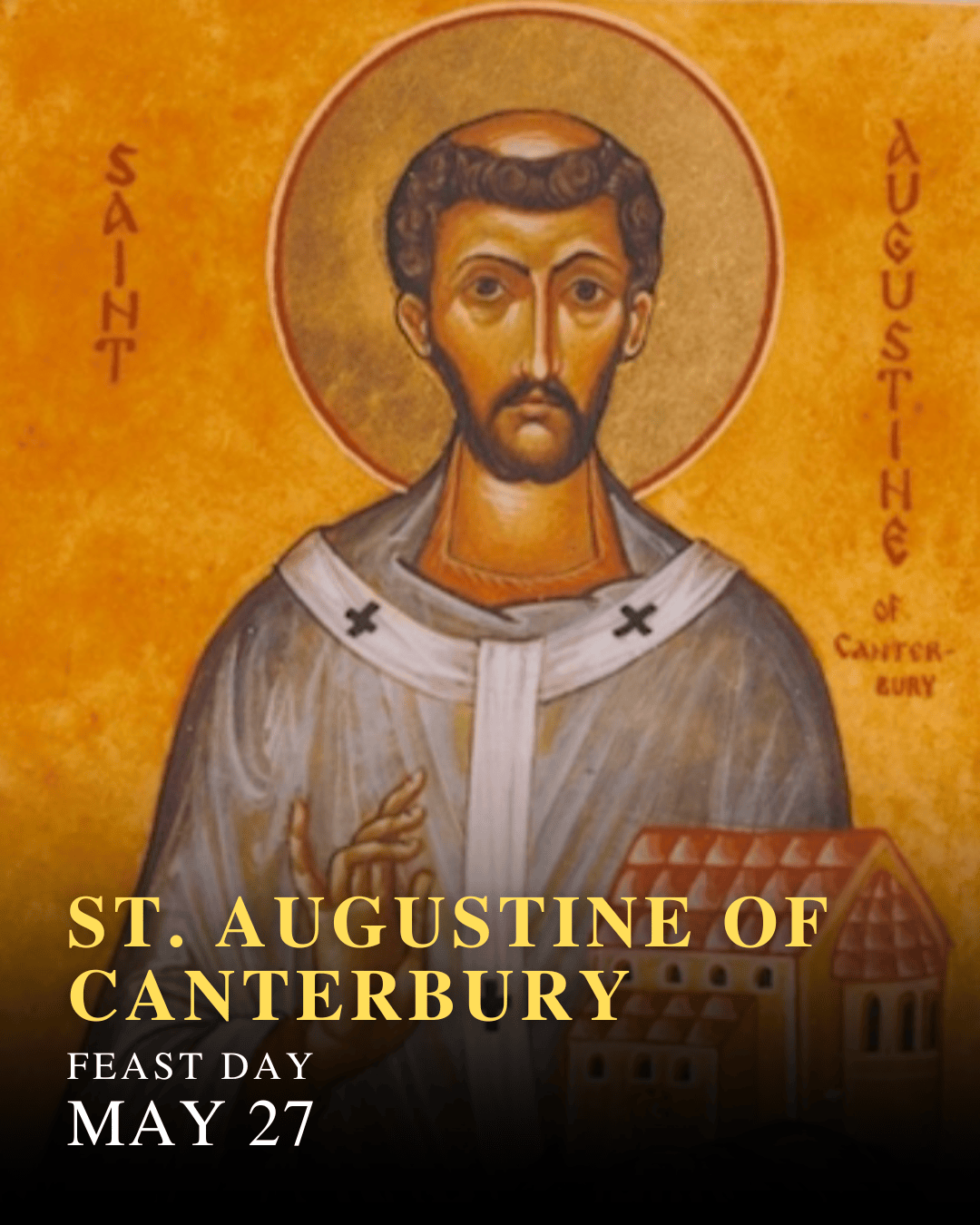
St. Augustine of Canterbury was a monk and missionary bishop sent by Pope Gregory the Great to bring the Christian faith to England. He is remembered as the apostle to the English because his mission helped establish Christianity in Anglo-Saxon England in a lasting way. His life is a powerful reminder that God often calls ordinary, hesitant, and imperfect people into missions that are much larger than they feel ready to carry.
Augustine was living as a monk in Rome when Pope Gregory entrusted him with the mission to evangelize the English people. This was not a small assignment. Augustine and his companions were being asked to leave the familiar world of their monastery and travel into a land that was culturally different, spiritually uncertain, and potentially dangerous. The journey itself required courage, and the mission required even more trust.
Tradition tells us that Augustine and the other monks became afraid along the way and wanted to turn back. This detail makes his story very human. He was not fearless from the beginning. He knew hesitation. He understood the anxiety that can come when God’s call feels too big. Yet with encouragement from Pope Gregory, Augustine continued. His eventual obedience bore great fruit.
When he arrived in England, Augustine preached with humility and patience. Through his efforts, many people came to know Christ, including King Ethelbert of Kent. Augustine was later appointed the first Archbishop of Canterbury. His mission helped lay foundations for the growth of the Church in England, and his life continues to speak to anyone who is being asked by God to step beyond comfort into trust.
St. Augustine of Canterbury’s mission began with obedience. He did not choose the mission for himself. He was sent. This is important because Christian mission is not always something we design according to our preferences. Sometimes God’s call comes through duty, circumstance, spiritual authority, family responsibility, or a quiet invitation in prayer. Augustine teaches us that obedience can open the door to grace we could not have planned on our own.
Obedience is not always easy. Augustine’s hesitation shows that he felt the weight of what was being asked. He was not being sent to do something simple or predictable. He had to trust that God would provide what he lacked. This makes his obedience more meaningful. Courage does not mean never feeling afraid. Courage means continuing to follow God even when fear is present.
Pope Gregory the Great encouraged Augustine and his companions to continue. This detail also reminds us that mission is not meant to be lived alone. God often gives encouragement through spiritual mentors, wise leaders, friends, family, and the wider Church. Augustine had to obey, but he was also supported.
His life invites us to reflect on our own moments of hesitation. Where is God asking us to be faithful? Where are we tempted to turn back because the path feels unfamiliar? Augustine reminds us that a yes given with trembling faith can still become fruitful in God’s hands.
St. Augustine followed God’s call even when the mission felt difficult. He teaches us to trust and obey when God asks us to step forward in faith.
He entered unknown lands and faced uncertainty. He reminds us that courage grows when we rely on God instead of waiting until we feel completely ready.
He continued despite fear, challenges, and the difficulty of mission. He encourages us to remain faithful when progress is slow or uncertain.
He brought others to Christ through preaching, patience, and witness. He shows us the importance of sharing our faith with humility and love.
When Augustine arrived in England, he encountered a land with complex religious and cultural realities. Some Christian roots remained from earlier centuries, but much of Anglo-Saxon England had returned to pagan practices. The mission required more than a single sermon or a quick conversion. It required patience, presence, and the slow work of building trust.
One of the most significant moments in Augustine’s mission was the conversion of King Ethelbert of Kent. Ethelbert’s wife, Queen Bertha, was already a Christian, and her faith helped prepare the way for the Gospel. Augustine’s preaching and witness eventually led the king to accept Christianity. This opened the door for many others to hear and receive the faith.
Augustine did not only preach. He helped organize the Church, establish places of worship, guide new believers, and form a Christian community. Evangelization is not only about introducing people to Christ once. It also involves helping them grow, worship, learn, and live as disciples. Augustine’s work helped create a lasting foundation for the Church in England.
His mission reminds us that evangelization often happens gradually. Some hearts are prepared over time. Some conversions require many quiet influences. God can use a spouse, a friend, a teacher, a missionary, a prayer, and a simple act of witness together in one person’s journey toward faith.
One of the most relatable parts of St. Augustine’s story is his fear. He and his companions reportedly wanted to stop the mission and return home before reaching England. Many saints experienced fear, hesitation, or uncertainty, and Augustine was no exception. This makes his holiness more approachable. He was not courageous because he never felt afraid. He became courageous by obeying God despite fear.
Fear often appears when God calls us into something unfamiliar. We may fear failure, rejection, criticism, change, or not having enough strength. Augustine’s story reminds us that fear does not automatically mean we are on the wrong path. Sometimes fear simply means we are stepping into a mission that requires deeper trust.
This can apply to ordinary life. A mother teaching her children the faith, a woman returning to the sacraments after years away, a person inviting a friend to Mass, a parish volunteer beginning a new ministry, or someone speaking gently about faith with family may all feel nervous. Mission often begins with a trembling heart.
Augustine teaches us to bring fear to God instead of letting fear make the decision. We can ask for courage, seek wise encouragement, and take the next faithful step. God does not always remove fear immediately, but He can give grace to move through it.
St. Augustine of Canterbury’s mission also teaches that evangelization requires patience and respect. Bringing the Gospel to a people is not the same as winning an argument. It involves listening, learning, building relationships, and presenting the faith with humility. Augustine had to enter a culture that was not his own and share Christ in a way that could be received.
Pope Gregory the Great gave practical guidance for the mission, encouraging a wise and gradual approach. This reminds us that evangelization should be rooted in charity and prudence. People are not projects. They are souls loved by God. The goal is not to pressure or control, but to invite others into the truth and love of Christ.
This lesson is deeply relevant today. Many Catholics want loved ones to return to the faith but feel unsure how to help. Augustine’s example suggests a gentle path: pray, live the faith sincerely, speak when appropriate, be patient, and trust God’s timing. Conversion is ultimately the work of grace.
Evangelization also begins with our own witness. A joyful, faithful, humble life can open hearts more effectively than forceful words. Augustine’s mission succeeded not only because he preached, but because he remained faithful and built a community of faith that others could see.
St. Augustine of Canterbury matters today because the Church still needs missionaries. Not everyone is called to travel to another country, but every Catholic is called to witness to Christ. Mission can happen in a home, parish, workplace, school, online community, friendship, or family conversation. The place may be ordinary, but the call is still real.
His story is especially encouraging because he was not perfectly confident. Many people wait to serve God until they feel fully ready. Augustine reminds us that readiness often comes after obedience, not before. We learn to trust by following. We grow in courage by taking the next step.
He also shows that one yes can affect generations. Augustine could not have known the full impact of his mission. He simply obeyed the call in front of him. Through that obedience, the faith took root in England in a powerful way. This reminds us that our small acts of faithfulness can have effects beyond what we see.
For Catholic women, his example can be a reminder that faith is meant to be shared. Teaching a child to pray, encouraging a friend, posting a gentle reflection, inviting someone to Mass, or living with visible trust in God can all be forms of evangelization.
One lesson from St. Augustine of Canterbury is that God can work through hesitant obedience. Augustine’s initial fear did not disqualify him. He continued, and God used his mission fruitfully. This is comforting for anyone who feels weak or unsure when facing a responsibility.
A second lesson is that mission requires community. Augustine did not travel alone. He went with companions and was supported by Pope Gregory. We also need the Church, prayer, friendship, and encouragement when trying to follow God’s call.
A third lesson is that evangelization takes patience. People do not always respond immediately. Cultures, families, and hearts often change slowly. Augustine’s mission required long-term commitment, not quick results. This teaches us to trust God’s timing.
Finally, Augustine teaches that the Gospel is worth sharing. If we truly believe Christ is the source of life, peace, and salvation, then love should move us to help others know Him too. Evangelization is not about pressure. It is about love.
You can ask St. Augustine of Canterbury to pray for you when you need courage to follow God’s call, patience in evangelization, or strength to step outside your comfort zone. He is a helpful intercessor for missionaries, converts, catechists, teachers, parents, parish leaders, and anyone trying to share the faith with love.
If you are afraid to speak about your faith, ask Augustine to help you be gentle and courageous. If someone you love is far from God, ask him to pray for their heart and for your patience. If you are beginning a new mission, ministry, or responsibility, ask him to help you trust God one step at a time.
His intercession can also be meaningful when praying for the renewal of faith in families and nations. Augustine helped bring Christianity to a people who needed the Gospel. We can ask him to pray for places where faith has grown cold and for hearts that need to rediscover Christ.
You may also grow spiritually through our Morning Prayer, Evening Prayer, and Healing Prayer pages. For other saints who helped bring people closer to Christ, you may enjoy reading about St. Philip Neri, St. Bernardine of Siena, and Bl. Francis Xavier Seelos.
St. Augustine of Canterbury reminds us that God often calls us beyond our comfort zones. His life shows that great things can happen when we say yes to God, even if our yes begins with fear. He did not know everything that would happen when he left Rome. He simply continued the mission entrusted to him.
Like St. Bernardine of Siena and St. Philip Neri, he helped renew faith and bring people closer to Christ. His example encourages us to trust God, share our faith, and remain faithful in our calling.
His story also teaches that obedience can become fruitful beyond what we imagine. One mission, one journey, one act of courage, one faithful yes can touch many lives. We may not see the full fruit of our obedience, but God can use it in ways that reach far beyond us.
St. Augustine invites us to follow God’s call with courage and trust. He reminds us that the Gospel is a gift meant to be shared and that even hesitant disciples can become faithful missionaries when they depend on grace.
“St. Augustine of Canterbury, help me to follow God’s call with courage and faith.”
— Prayer inspired by his life