St. Paul VI
Pope of Renewal and Faith
1897–1978
Pope of Renewal and Faith
1897–1978
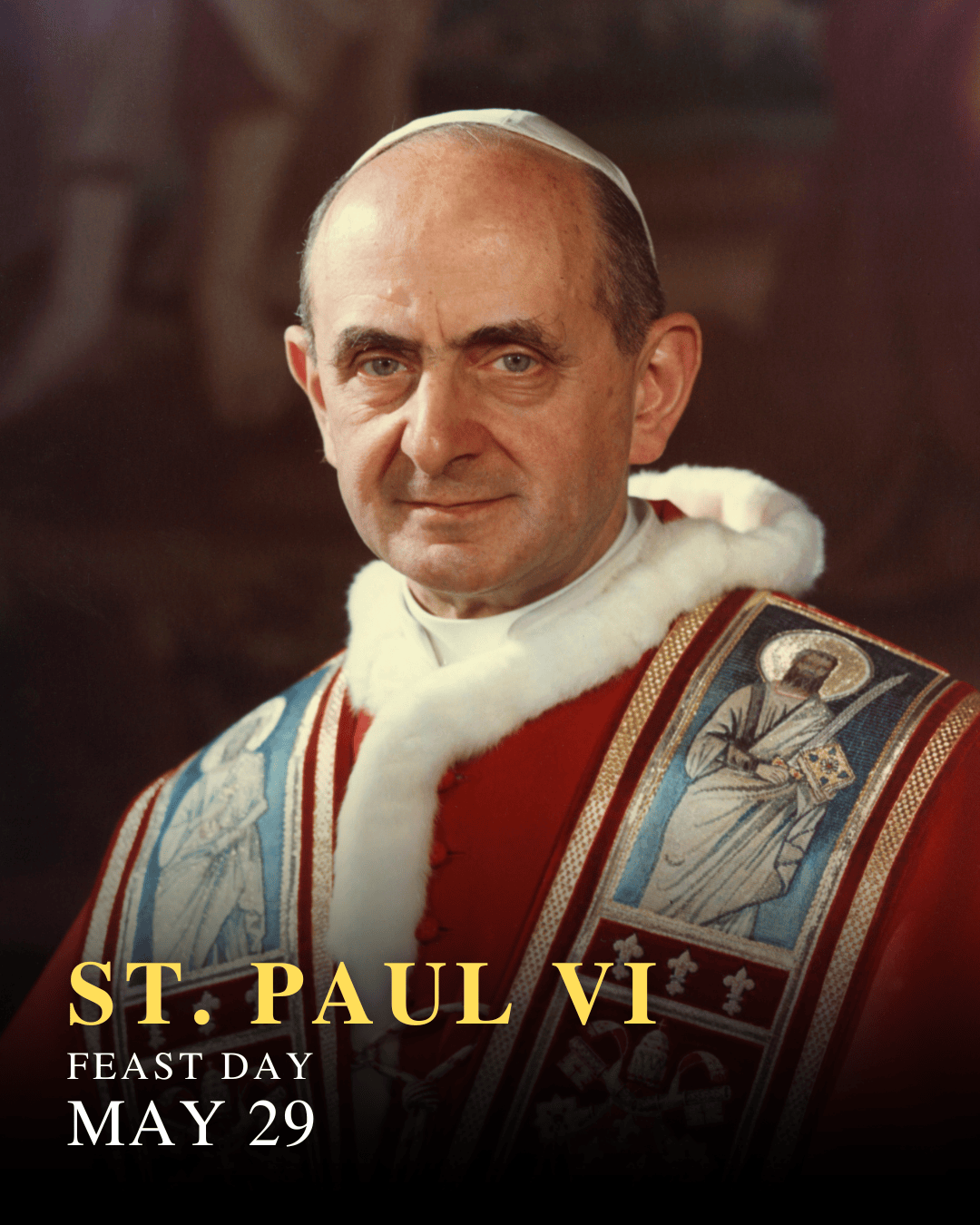
St. Paul VI was the pope who helped guide the Catholic Church through one of the most important and challenging periods of modern history. Born Giovanni Battista Montini in Italy in 1897, he lived through war, social change, political unrest, and a rapidly changing world. When he became pope in 1963, the Second Vatican Council was already underway, and he carried the responsibility of continuing it, completing it, and helping the Church begin to live out its teachings with faithfulness and care.
His life was not marked by loud popularity or easy approval. Instead, it was marked by responsibility, prayer, careful discernment, and deep love for Christ and His Church. St. Paul VI knew that the Church needed to speak to the modern world, but he also knew that true renewal could never mean abandoning the truth of the Gospel. He wanted Catholics to engage the world with charity, courage, and hope while remaining rooted in Christ.
Many people remember him for his encyclical Humanae Vitae, his teaching on marriage, human love, and the sacredness of life. Others remember him for his work in completing the Second Vatican Council, his travels as a missionary pope, his efforts toward peace, and his desire for dialogue with people of different cultures, nations, and beliefs. At the center of all these efforts was a shepherd who wanted to lead souls closer to Jesus.
St. Paul VI became pope during a time when the world was asking many difficult questions. Technology was advancing quickly. Families were facing new pressures. Nations were dealing with conflict, poverty, and social unrest. Many Catholics were also trying to understand how to live their faith in a world that felt very different from the one their parents and grandparents had known. This was the setting in which St. Paul VI served as pope.
He did not pretend that the world was simple. He understood that modern life brought real questions, real struggles, and real confusion. But he also believed that the Church had something beautiful and necessary to offer: the truth of Christ, the dignity of the human person, the call to holiness, and the hope of eternal life. He wanted the Church to speak with clarity, not harshness; with compassion, not compromise; with confidence, not fear.
This balance was not easy. Some people thought he moved too slowly. Others thought he moved too quickly. Some wanted change without limits, while others feared almost any change at all. St. Paul VI often found himself carrying the weight of both expectation and criticism. Yet he continued to pray, teach, write, travel, and lead. His example reminds us that faithfulness is not always applauded in the moment. Sometimes obedience to God requires patience, misunderstanding, and quiet perseverance.
For Catholic women today, his life can be especially meaningful. Many women are trying to remain faithful while navigating family life, marriage, motherhood, work, loneliness, grief, cultural pressure, or spiritual dryness. St. Paul VI shows that holiness does not mean having an easy path. It means choosing Christ again and again, even when the path is heavy.
St. Paul VI showed courage by leading the Church during a time of confusion and disagreement. He did not simply follow popular opinion. He sought to remain faithful to Christ, even when his decisions brought criticism. His courage teaches us that Christian faith is not only about believing quietly in our hearts, but also about standing for truth with humility and love.
His life was deeply rooted in fidelity to the Church and to the Gospel. He understood that the teachings of the Church are not obstacles to happiness, but paths that help us live according to God’s design. His faithfulness encourages us to stay close to the sacraments, to trust Church teaching, and to keep choosing God even when the world offers easier answers.
St. Paul VI was thoughtful and careful. He listened, reflected, prayed, and discerned. He did not treat leadership as a chance to control others, but as a responsibility before God. His wisdom reminds us to slow down before making important decisions, to ask for the guidance of the Holy Spirit, and to seek truth rather than emotional reaction.
He carried burdens that were often lonely. He faced public criticism, internal Church tensions, and the heavy task of guiding millions of Catholics. Still, he continued his mission. His perseverance teaches us that holiness often grows through steady faithfulness in hidden places, not only through dramatic moments.
St. Paul VI loved the Church as a mother, teacher, and home for souls. He did not see the Church as merely an institution or organization. He saw her as the Body of Christ, called to bring salvation, mercy, truth, and holiness to the world. This love shaped the way he served. He wanted the Church to be renewed, but not emptied of her identity. He wanted Catholics to understand their faith more deeply, participate more fully in the liturgy, and live as witnesses in everyday life.
the Second Vatican Council was a central part of his papacy. After Pope St. John XXIII opened the council, St. Paul VI continued and completed it. He worked to guide its documents and help the Church understand how to bring the Gospel into the modern world. This was not renewal for the sake of being fashionable. It was renewal for the sake of mission. The Church exists to proclaim Jesus Christ, and St. Paul VI wanted Catholics to take that mission seriously.
He also had a deep concern for unity. He reached out to other Christians, encouraged dialogue, and desired healing where division had wounded the Body of Christ. He traveled outside Italy and became one of the first modern popes to make international apostolic journeys. These trips showed that the pope is not only a leader in Rome, but a shepherd for the whole world. His journeys helped many people see the Church as truly universal.
His love for the Church was not sentimental. It was sacrificial. He knew that loving the Church sometimes meant suffering for her, defending her, correcting misunderstandings, and carrying burdens that others could not see. This kind of love is a lesson for all Catholics. We are called not only to receive from the Church, but also to pray for her, serve her, and remain faithful even when we see human weakness within her members.
One of the most remembered parts of St. Paul VI’s legacy is his teaching on the dignity of human life and the meaning of married love. In Humanae Vitae, he wrote about the sacredness of life, the gift of marriage, and the connection between love and openness to life. This teaching was difficult for many people to receive, especially during a time when the culture was changing quickly. Yet St. Paul VI believed the Church had a duty to protect the truth about the human person.
His teaching was not rooted in fear of the body or rejection of love. It was rooted in reverence for the body, reverence for marriage, and reverence for the way God created love to be faithful, generous, and life-giving. He saw that when society separates love from responsibility, and freedom from truth, people can be wounded. His words continue to challenge Catholics to see marriage and family not as private preferences, but as sacred vocations.
For married women, mothers, single women, widows, and consecrated women, his witness can still speak powerfully. He reminds us that every human life has value. He reminds us that our bodies matter. He reminds us that love is not only feeling, attraction, or convenience. Real love is faithful. Real love sacrifices. Real love protects life. Real love honors the dignity of the other person.
This does not mean every Catholic has understood or lived these teachings perfectly. Many people carry wounds, regrets, confusion, or difficult personal histories. St. Paul VI’s life invites us not to despair, but to return to God with honesty. The truth of the Church is never separated from mercy. Christ calls us to conversion because He loves us, not because He wants to shame us. St. Paul VI helps us see that truth and compassion belong together.
St. Paul VI is a saint for anyone who feels the tension between faith and the modern world. He knew what it meant to live in changing times. He knew what it meant to make decisions when not everyone would understand. He knew what it meant to speak truth in a culture that often wanted easier answers. Because of this, his life feels very relevant today.
Many Catholic women are surrounded by messages that tell them faith should stay private, morality should be flexible, and truth should adjust to personal preference. St. Paul VI reminds us that following Christ will sometimes make us different. But being different for Christ is not something to fear. It can become a quiet form of witness. A woman who prays, forgives, honors life, protects her family, speaks kindly, chooses modesty, seeks confession, and remains faithful in hidden sacrifices is already preaching the Gospel with her life.
His life also teaches us the importance of hope. St. Paul VI did not lead during an easy age, but he did not give up on the Church or the world. He believed the Gospel still had power. He believed the Holy Spirit still guided the Church. He believed modern people still needed Christ. That kind of hope is needed today, especially when the news feels discouraging, families feel divided, and faith can feel difficult to pass on to the next generation.
St. Paul VI encourages us to remain steady. We do not have to solve every problem in the Church or the world. We do not have to carry every burden alone. But we are called to be faithful in what God has placed before us. We can pray. We can learn the faith. We can teach our children. We can support our parishes. We can speak truth with love. We can choose holiness in ordinary decisions.
One way to grow spiritually with St. Paul VI is to ask where God is calling you to greater courage. For some, courage may mean returning to Mass after a long time away. For others, it may mean going to confession, forgiving someone, defending Church teaching kindly, or choosing prayer when the day feels busy. Courage is not always dramatic. Sometimes it is simply doing the right thing quietly and consistently.
Another way is to practice discernment. St. Paul VI was a careful and prayerful leader. He did not rush important matters. In daily life, discernment may look like pausing before reacting, asking whether a decision leads closer to God, or inviting the Holy Spirit into family choices, financial worries, relationships, and personal struggles. A woman who learns to discern with God becomes less ruled by pressure and more rooted in peace.
You can also imitate his love for the Church. This may mean learning more about Catholic teaching, praying for the pope, supporting priests and religious, volunteering in your parish, or simply speaking about the Church with reverence instead of bitterness. Loving the Church does not mean ignoring problems. It means refusing to abandon the Bride of Christ because of human weakness.
Finally, his example invites us to stay close to Christ in the sacraments. The Church is not renewed by opinions alone. The Church is renewed by saints. Every confession, every worthy reception of Holy Communion, every act of charity, every hidden prayer, and every sacrifice offered to God helps renew the Church from within. St. Paul VI reminds us that holiness is the deepest form of reform.
St. Paul VI reminds us that faithfulness sometimes requires standing firm in truth, even when it is difficult. His life is a reminder that the Catholic faith is not meant to be shaped by every passing cultural trend. Instead, it is meant to shape us into people who belong more fully to Christ.
Like St. Pius V and St. Gregory VII, he led the Church with courage during times of challenge. Like St. John Paul II, he helped the Church speak to the modern world with confidence and missionary zeal. His witness belongs to every Catholic who wants to remain faithful while living in a complicated world.
His life encourages us to trust God, to remain faithful, and to live our beliefs with conviction. He shows that leadership is not about pleasing everyone. It is about serving God with humility. He also shows that holiness can exist in the middle of pressure, criticism, responsibility, and uncertainty.
You may also grow in your spiritual life through our Morning Prayer and Evening Prayer pages. A simple rhythm of prayer can help you live with the same kind of steady faith that marked St. Paul VI’s life.
He invites us to live with courage, to seek truth, and to follow Christ faithfully. His feast day can be a moment to ask: Where is God calling me to greater faithfulness? Where have I been tempted to compromise? Where do I need to trust the Holy Spirit more deeply?
“St. Paul VI, help me to remain faithful to truth and to trust God in all things.”
— Prayer inspired by his life