St. Paschal Baylon
Apostle of the Eucharist and Humble Servant
1540–1592
Apostle of the Eucharist and Humble Servant
1540–1592
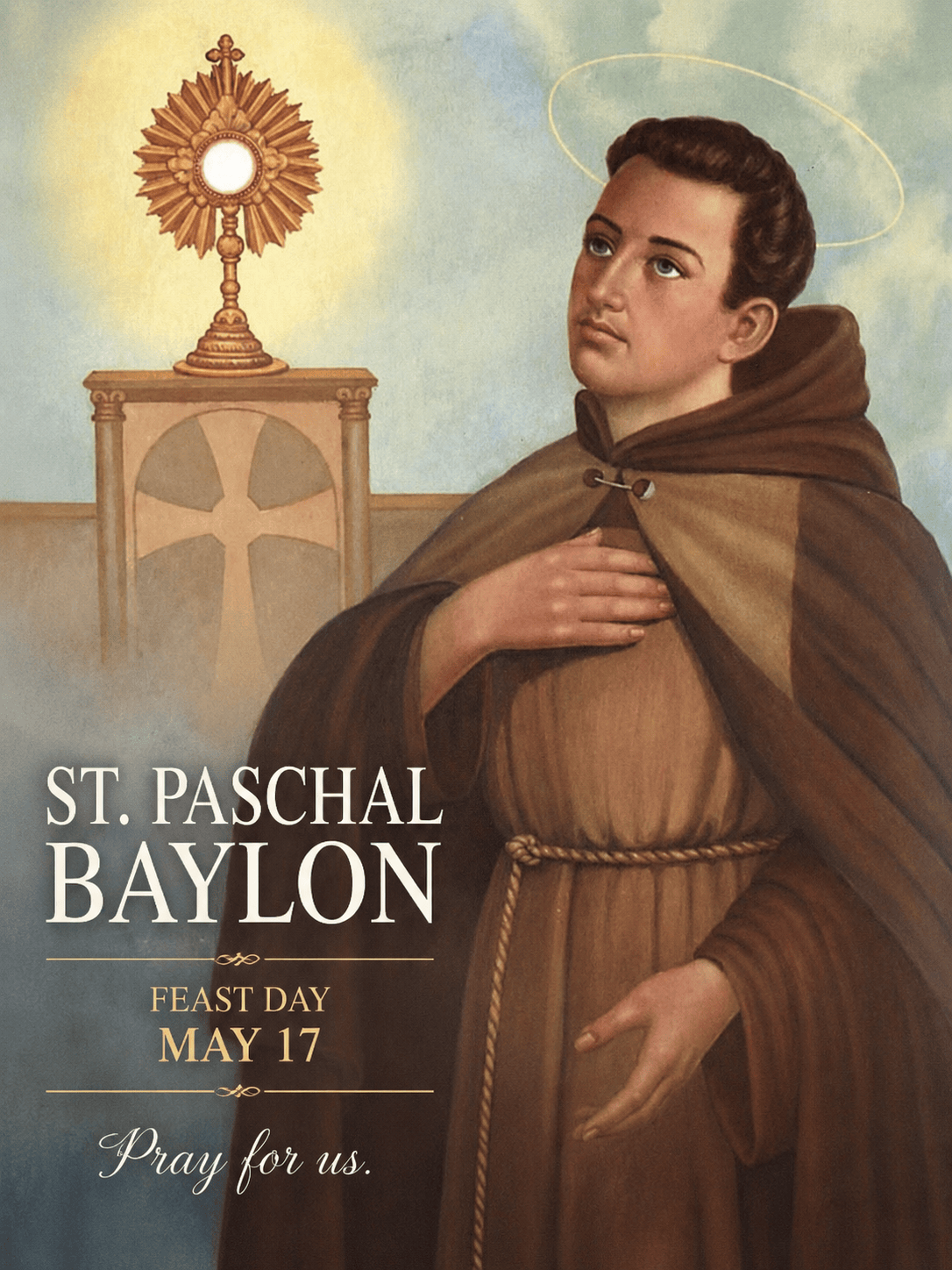
St. Paschal Baylon was born in Spain in 1540 into a very poor farming family. From an early age, his life looked ordinary by worldly standards. He did not grow up with wealth, influence, or formal education. Instead, he spent much of his youth helping his family and working as a shepherd.
Long days in the fields became more than work for him. While caring for sheep, he developed a habit that would shape his entire life: constant prayer. The quietness of nature became a place where he learned to speak with God. Instead of seeing work as a distraction from faith, Paschal turned ordinary moments into opportunities for prayer.
Those who knew him noticed that even as a young man, he had a deep desire for God. He often paused to pray whenever church bells rang, even from a distance. If he passed near a church, he would stop and spend time before the Blessed Sacrament whenever possible.
As he grew older, Paschal felt called to religious life and eventually joined the Franciscan Order as a lay brother. Unlike priests or scholars, lay brothers often carried out practical duties within the community. Paschal accepted humble work without complaint. He served as a porter, cook, messenger, and helper wherever he was needed.
Though he lacked formal education, many people were surprised by the depth of his spiritual wisdom. He had a remarkable understanding of faith and spoke with simple sincerity. People sought his counsel because holiness often teaches more than academic knowledge alone.
Above all, St. Paschal became known for his deep love for the Eucharist. He spent long hours in adoration before the Blessed Sacrament and desired to remain close to Jesus. His devotion was not dramatic or attention-seeking. It was quiet, faithful, and consistent.
During his lifetime, stories spread of extraordinary spiritual experiences and miracles associated with him. Yet Paschal never sought recognition. He remained humble and saw himself simply as a servant of God.
He died on May 17, 1592. Tradition tells us that during his funeral Mass, witnesses saw his eyes open and close at the elevation of the Eucharist. Whether remembered for that event or for his life itself, St. Paschal continues to remind believers that deep holiness often grows in hidden places.
Today he is honored as the patron saint of Eucharistic devotion and Eucharistic congresses. His life continues to inspire Catholics to rediscover prayer, simplicity, and love for Jesus truly present in the Blessed Sacrament.
Modern life rarely feels quiet. Phones constantly buzz. Schedules stay full. Many people move from one task to another without stopping long enough to rest spiritually.
St. Paschal Baylon lived centuries ago, but his life speaks directly into modern struggles. He teaches something many people desperately need today: being close to God does not require a complicated life.
Many people believe holiness belongs only to priests, religious communities, missionaries, or people who appear spiritually extraordinary. Paschal's life tells a different story.
He spent years doing ordinary work. He cleaned, cooked, delivered messages, and served others quietly. Yet he became a saint because he brought God into ordinary life.
His example reminds us that holiness can happen while caring for children, working from home, doing laundry, preparing meals, sitting quietly in prayer, or completing ordinary responsibilities.
St. Paschal reminds us that God is often found not in extraordinary moments, but in ordinary faithfulness.
St. Paschal loved the Blessed Sacrament deeply. He teaches us to spend time with Jesus in the Eucharist and to remember that prayer is not only something we do when life is peaceful.
He embraced simple tasks with joy. He reminds us that no act of service is too small when it is offered with love.
His life was rooted in prayer. He encourages us to stay close to God throughout the day, even during work, chores, and ordinary routines.
He served with a peaceful heart. He shows us that joy does not come from status or comfort, but from loving God faithfully.
St. Paschal Baylon reminds us that the Eucharist is not simply a religious symbol or tradition. For Catholics, the Eucharist is the true presence of Christ. Paschal centered his entire life around that reality.
In a culture filled with noise and distraction, his witness encourages believers to return to silence, adoration, and prayer. He reminds us that we do not always need more activity in order to grow spiritually. Sometimes, what we need most is to become still before God.
His life also teaches something deeply comforting: holiness does not require a public platform. St. Paschal never preached to large crowds. He never held positions of importance. He did not become known because of achievements or status.
He became holy through consistency.
He prayed consistently. Served consistently. Loved consistently.
Like St. Joseph the Worker and St. Isidore the Farmer, he shows that God often works through simple lives.
His example invites us to slow down and ask difficult but beautiful questions: Do I create time for prayer? Do I notice God's presence in ordinary moments? Do I make room for silence? Do I seek Christ in the Eucharist?
You may also deepen your prayer life through our Morning Prayer and Evening Prayer pages.
St. Paschal's life reminds us that faithfulness in small things can become extraordinary in God's hands.
The saints are not meant to remain distant historical figures. Their lives become practical examples for our own. St. Paschal Baylon gives us a simple but powerful model of faith that can be lived in ordinary homes, workplaces, parishes, and families.
Prayer does not only happen inside church walls. Paschal prayed while working and carrying out daily responsibilities. His life reminds us that even small pauses can become prayer when the heart turns toward God.
Many important acts of love happen where nobody notices. Preparing food, helping a family member, answering a need, or doing a task without complaint can become holy when done with charity.
Paschal's deep Eucharistic devotion reminds us that relationships grow through time spent together. If we want to love Christ more deeply, we must make room for Him in our day.
Humility is not thinking less of yourself. It is thinking less about yourself and more about loving God and serving others. St. Paschal shows that humility gives peace to the soul because it frees us from constantly needing attention or recognition.
His life is a gentle invitation to make faith part of daily living. We do not have to wait for perfect conditions to become closer to God. We can begin with the work, prayer, and responsibilities already in front of us.
“St. Paschal, help me to love the Eucharist and live with humility and joy.”
— Prayer inspired by his life