St. John the Baptist is one of the most important figures in salvation history because his entire life pointed toward Jesus Christ.
The Church honors St. John the Baptist as a prophet, a witness, a preacher of repentance, and a martyr for the truth. He stands at a unique place in Scripture. He belongs to the line of the prophets, yet he also appears at the beginning of the Gospel story, preparing the people to receive the Messiah.
John did not seek attention for himself. His mission was to make Christ known. He called people to repent, baptized them in the Jordan River, and told them that someone greater was coming. When Jesus appeared, John recognized Him and directed others to Him. His famous words reveal the heart of his vocation: “He must increase; I must decrease.”
Catholics can learn a great deal from St. John the Baptist. His life reminds us that holiness is not about being popular, comfortable, or praised. It is about faithfulness to God. John lived simply, spoke courageously, and remained loyal to the truth even when it cost him his life.
Simple reminder: St. John the Baptist does not draw attention away from Jesus. He helps us recognize Jesus more clearly and respond to Him with repentance, humility, and faith.
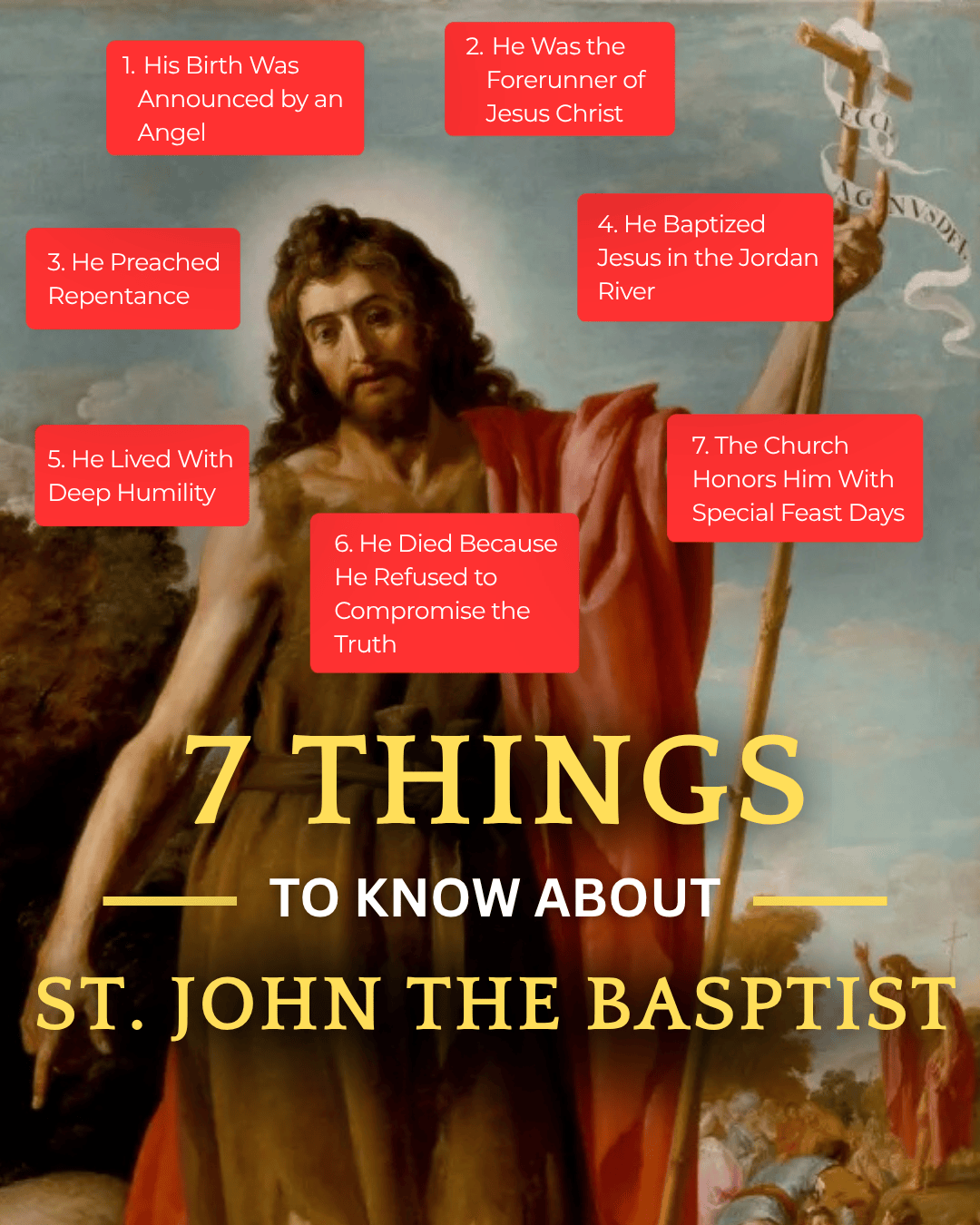
St. John the Baptist prepared the way for Jesus and called people to repentance.
1. His Birth Was Announced by an Angel
The story of St. John the Baptist begins before his birth. In the Gospel of Luke, his parents, Zechariah and Elizabeth, are described as righteous before God. They were faithful, but they had no child, and Elizabeth was advanced in years. Humanly speaking, a child seemed impossible.
Then the angel Gabriel appeared to Zechariah while he was serving in the Temple. Gabriel announced that Elizabeth would bear a son and that they were to name him John. This child would be great before the Lord, filled with the Holy Spirit, and called to turn many hearts back to God.
John’s birth shows that his mission was not accidental. God prepared him for a specific purpose. He was chosen to prepare the people for the coming of Christ. Even before he could speak, his life was already part of God’s saving plan.
This is one reason Catholics see John as a powerful example of vocation. A vocation is not simply a personal career choice or private dream. It is a calling from God. John’s calling was demanding, but it was also filled with meaning. He belonged to God’s plan, and his life bore fruit because he accepted that mission.
2. He Was the Forerunner of Jesus Christ
St. John the Baptist is often called the forerunner of Christ. A forerunner is someone who comes before another person to prepare the way. John’s mission was to prepare the hearts of the people so they would be ready to receive Jesus.
The Gospels connect John with the prophecy of Isaiah: “A voice of one crying out in the desert, ‘Prepare the way of the Lord, make straight his paths.’” John fulfilled this role by preaching in the wilderness and calling people back to God.
John did not claim to be the Messiah. When people wondered who he was, he made it clear that he was not the Christ. He understood his place. He was a servant, a witness, and a voice pointing beyond himself.
This is one of the most beautiful things about St. John the Baptist. He was important, but he was not self-important. He had a powerful ministry, but he did not turn that ministry into a platform for his own glory. He knew that his purpose was to lead people to Jesus.
For Catholics today, John’s example is especially helpful. Whether we are parents, teachers, catechists, ministry leaders, friends, or simply people trying to live our faith, our mission is similar in a humble way. We are not the Savior. We are called to point others to Him.
3. He Preached Repentance
John’s message was direct: repent, because the kingdom of heaven is at hand. He did not preach comfort without conversion. He called people to turn away from sin and return to God with sincere hearts.
Repentance is more than feeling sorry. In the biblical sense, it means a real turning of the heart and life. It means recognizing sin, asking for God’s mercy, and choosing a new direction. John’s baptism in the Jordan was a sign of this desire for cleansing and renewal.
John’s preaching reminds Catholics that preparing for Jesus requires honesty. We cannot welcome Christ deeply while clinging tightly to sin. God’s mercy is real, but mercy is meant to heal and transform us. John prepared the people by helping them recognize their need for conversion.
This message is still needed today. It is easy to reduce faith to inspiration, encouragement, or tradition. Those things can be good, but the Gospel also calls us to change. John reminds us that the road to Christ often begins with a humble examination of conscience.
Conversion
John called people to turn away from sin and return to God with sincere hearts.
Honesty
His preaching invited people to face the truth about their lives and seek God’s mercy.
Preparation
Repentance prepared the people to receive Jesus, the promised Messiah.
Renewal
John’s message reminds Catholics that God calls every soul to a new beginning.
4. He Baptized Jesus in the Jordan River
One of the most important moments in John’s life was the Baptism of Jesus. Jesus came to the Jordan River to be baptized by John. John recognized that Jesus was greater than he was and hesitated, saying that he needed to be baptized by Jesus.
Jesus still chose to receive baptism from John, not because He needed repentance, but because He was fulfilling the Father’s plan. At this moment, Jesus was publicly revealed. The heavens opened, the Spirit descended like a dove, and the voice of the Father declared Jesus to be His beloved Son.
The Baptism of Jesus is not the same as Christian sacramental Baptism in the full sense established through Christ, but it is deeply meaningful. It marks the beginning of Jesus’ public ministry and reveals the Holy Trinity: the Son is baptized, the Spirit descends, and the Father speaks.
John’s role in this moment shows his humility and obedience. He did what God asked of him, even when he knew he was unworthy compared to the One standing before him. He understood that his ministry reached its fulfillment when Jesus was revealed.
5. He Lived With Deep Humility
St. John the Baptist was not weak or timid. He was bold, clear, and courageous. Yet he was also deeply humble. True humility does not mean pretending we have no gifts. It means knowing that every gift comes from God and must be used for His glory.
John had followers. People came from many places to hear him preach. Some wondered whether he might be the Messiah. In that situation, it would have been easy for John to enjoy the attention or allow confusion to grow. Instead, he consistently directed people away from himself and toward Jesus.
When John saw Jesus, he said, “Behold, the Lamb of God.” This statement is repeated at every Mass before Holy Communion, reminding Catholics that Jesus is the Lamb who takes away the sins of the world. John’s words still help the Church recognize Christ.
His humility is also seen in his statement, “He must increase; I must decrease.” This is not self-hatred. It is holy freedom. John was not trying to build a name for himself. He wanted Christ to be known, loved, and followed.
This lesson matters for every Christian. Much of modern life encourages self-promotion. John teaches another way. We can serve faithfully, speak truthfully, use our gifts generously, and still remember that the glory belongs to God.
6. He Died Because He Refused to Compromise the Truth
St. John the Baptist did not only preach repentance to crowds. He also spoke truth to those in power. He confronted Herod because Herod had taken Herodias, his brother’s wife. John’s words were not politically convenient, but they were morally true.
Because of this, John was imprisoned. Later, through the anger of Herodias and the rash promise of Herod, John was beheaded. His death was unjust, cruel, and worldly. Yet from the perspective of faith, John remained victorious because he stayed faithful to God.
The Church honors John as a martyr because he gave witness to the truth. He did not die because he was seeking conflict. He died because he would not pretend that sin was good or that God’s law did not matter.
His martyrdom challenges Catholics today. Speaking truth requires prudence, charity, and humility, but it also requires courage. John shows that love and truth belong together. Real love does not flatter people into spiritual danger. Real love desires their salvation.
John’s death also reminds us that holiness is not always rewarded by the world. Faithfulness may bring misunderstanding, rejection, or suffering. Still, the Christian is called to belong first to God.
7. The Church Honors Him With Special Feast Days
St. John the Baptist is honored in a special way in the liturgical life of the Church. Most saints are celebrated on the day of their death, which is often called their birth into eternal life. John is unusual because the Church celebrates both his birth and his martyrdom.
The Nativity of St. John the Baptist is celebrated on June 24. This feast honors his birth and the joy surrounding his mission. His birth was a sign that God was acting in history and preparing the people for the coming of Christ.
The Passion or Beheading of St. John the Baptist is commemorated on August 29. This day remembers his martyrdom and his courageous witness to the truth. Together, these two feast days help Catholics see the whole shape of John’s life: chosen by God, faithful in mission, humble before Christ, and courageous unto death.
These feast days are not only historical reminders. They are invitations. On June 24, we can thank God for the gift of John’s life and ask for the grace to prepare room for Christ in our hearts. On August 29, we can ask for courage to remain faithful to truth even when it is difficult.
What Catholics Can Learn From St. John the Baptist
St. John the Baptist teaches Catholics that a faithful life is a life pointed toward Christ. His greatness came from his obedience to God, not from comfort, wealth, or popularity. He knew who he was, and he knew who he was not. That clarity made him free.
He teaches us to prepare the way for Jesus in our own lives. This may begin with repentance, Confession, prayer, and a renewed desire to live according to the Gospel. It may also mean helping our families become more centered on Christ through small daily choices.
John also teaches us the value of humility. He did not need to be the center. He found joy in seeing others go to Jesus. This is a beautiful lesson for parents, catechists, ministry leaders, and anyone who serves the Church. Our goal is not to make people dependent on us. Our goal is to lead them to Christ.
Finally, John teaches courage. He spoke the truth when it was unpopular. He remained faithful when it cost him his freedom and his life. In a world that often avoids difficult truths, John reminds us that holiness requires both love and conviction.
Prepare your heart for Christ
Ask God to show you where repentance, healing, and renewed faith are needed in your life.
Practice humility
Let John’s words guide you: Christ must increase. Our pride, selfishness, and fear must decrease.
Witness to the truth with charity
Ask St. John the Baptist to help you speak and live the truth with courage, patience, and love.
A Simple Prayer to St. John the Baptist
Prayer for Humility and Courage
St. John the Baptist, faithful prophet and forerunner of Christ, pray for me. Help me prepare my heart for Jesus, turn away from sin, and live with humility. Teach me to point others to the Lord and to speak the truth with courage and love. May Christ increase in my life each day. Amen.
This prayer can be used on the feast of St. John the Baptist, before Confession, during Advent, or anytime you want to grow in humility and courage. His example is especially helpful when we need to return to God with honesty or stand firm in the truth with charity.
Frequently Asked Questions About St. John the Baptist
Who was St. John the Baptist?
St. John the Baptist was the prophet who prepared the way for Jesus Christ. He preached repentance, baptized in the Jordan River, and pointed people to Jesus as the Lamb of God.
Why is St. John the Baptist important?
He is important because he served as the forerunner of Christ. His mission was to prepare people for Jesus through repentance, baptism, humility, and faithful witness.
Did St. John the Baptist baptize Jesus?
Yes. John baptized Jesus in the Jordan River. This event revealed Jesus publicly and marked the beginning of His public ministry.
What did St. John the Baptist preach?
John preached repentance and called people to prepare the way of the Lord. He urged people to turn away from sin and return to God.
When is the feast day of St. John the Baptist?
The Church celebrates the Nativity of St. John the Baptist on June 24 and commemorates his Passion or Beheading on August 29.
How did St. John the Baptist die?
St. John the Baptist was imprisoned and beheaded after speaking the truth about Herod’s unlawful relationship with Herodias.
What can Catholics learn from St. John the Baptist?
Catholics can learn repentance, humility, courage, faithfulness, and the importance of pointing others to Jesus Christ.
Let St. John the Baptist Help You Prepare the Way for Jesus
St. John the Baptist reminds us that the Christian life is not about drawing attention to ourselves. It is about preparing our hearts for Christ and helping others recognize Him. May his example lead you to deeper repentance, stronger faith, humble service, and courageous love for the truth.
Explore More Catholic Saints