Corpus Christi is one of the most beautiful feasts in the Catholic Church because it turns our attention to the heart of Catholic worship: Jesus Christ truly present in the Eucharist.
The words Corpus Christi mean Body of Christ. The full name of the feast is the Solemnity of the Most Holy Body and Blood of Christ. On this day, Catholics give special honor to Jesus in the Blessed Sacrament and remember that the Eucharist is not merely a symbol, a reminder, or a religious tradition. It is Christ Himself, given to us as true food for the soul.
Every Mass is centered on the Eucharist, but Corpus Christi gives the Church a special opportunity to pause, adore, and publicly proclaim what Catholics believe. Jesus remains with His Church in a real and sacramental way. He feeds His people, strengthens them in grace, and invites them into deeper communion with Him.
This feast is especially meaningful because it helps Catholics recover reverence. In daily life, it is easy to become distracted, rushed, or spiritually tired. Even sacred things can begin to feel familiar when we encounter them often. Corpus Christi gently calls the heart back to wonder. It reminds us that when we come before the tabernacle, attend Mass, or receive Holy Communion, we are not approaching an ordinary thing. We are approaching the Lord.
Simple reminder: Corpus Christi is a feast of love, reverence, and gratitude. It reminds Catholics that Jesus does not only teach us from a distance. He gives Himself to us in the Eucharist.
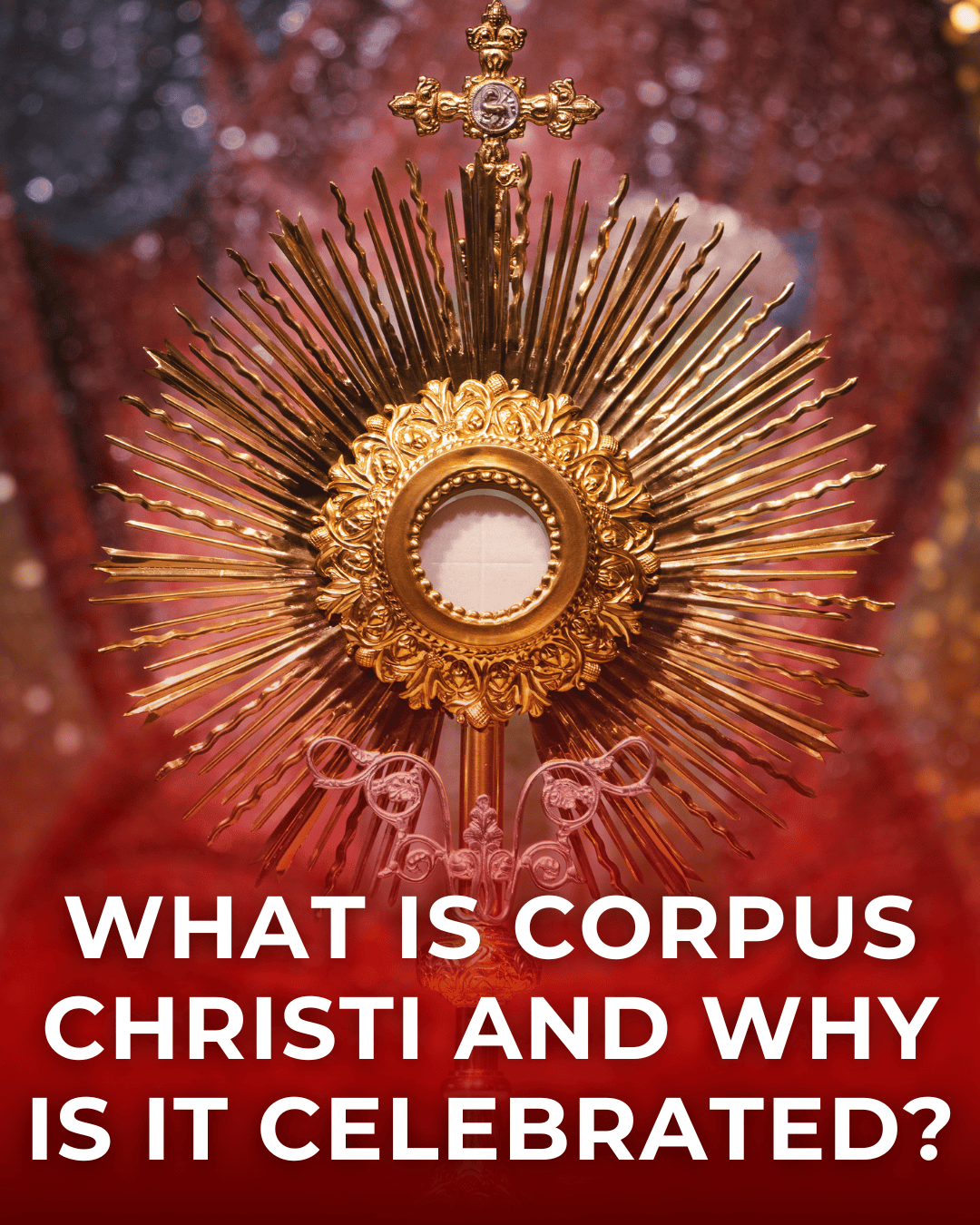
Corpus Christi honors the Most Holy Body and Blood of Christ and renews Catholic devotion to the Eucharist.
What Does Corpus Christi Mean?
Corpus Christi is a Latin phrase that means Body of Christ. The feast is officially called the Solemnity of the Most Holy Body and Blood of Christ because it honors the whole mystery of the Eucharist: Christ’s Body, Blood, Soul, and Divinity.
At Mass, Catholics believe that the bread and wine truly become the Body and Blood of Jesus Christ through the power of the Holy Spirit and the words of consecration spoken by the priest. The appearances of bread and wine remain, but the reality is changed. This mystery is known as transubstantiation.
This belief is at the center of Catholic faith. The Eucharist is not simply a reminder of Jesus. It is His sacramental presence. When Catholics receive Holy Communion, they receive Christ Himself. When Catholics adore the Blessed Sacrament, they are adoring Jesus truly present.
Corpus Christi helps Catholics remember the greatness of this gift. Because the Eucharist is familiar, it can sometimes be easy to receive without deep attention. This feast gently calls the heart back to wonder, reverence, and gratitude.
Why Is Corpus Christi Celebrated?
Catholics celebrate Corpus Christi to honor Jesus in the Eucharist and to publicly witness to the Real Presence. The Church already celebrates the institution of the Eucharist on Holy Thursday, but Holy Thursday also includes the beginning of the Passion. Because of that solemn setting, Corpus Christi gives the Church another day to focus with joy and gratitude on the gift of the Eucharist.
This feast reminds Catholics that the Eucharist is the source and summit of the Christian life. Everything in the Church flows from Christ and leads back to Christ. In the Eucharist, Jesus gives Himself completely. He nourishes the faithful, unites them to His sacrifice, strengthens them against sin, and draws them into communion with the Church.
Corpus Christi is also a public feast. In many places, Catholics process through streets with the Blessed Sacrament. This is a visible way of saying that Jesus belongs not only inside the church building, but also at the center of our homes, communities, cities, and daily lives.
In a world where many people feel spiritually hungry, Corpus Christi points to the One who truly satisfies. Jesus gives more than encouragement. He gives Himself. The feast invites Catholics to ask a simple but important question: Do I truly recognize the gift I have been given in the Eucharist?
Corpus Christi and the Words of Jesus
The Catholic belief in the Eucharist begins with Jesus Himself. At the Last Supper, He took bread, blessed it, broke it, and gave it to His disciples, saying, “This is my body.” Then He took the cup and said, “This is my blood.” Catholics take these words seriously because Christ Himself spoke them.
The Gospel of John also gives a powerful Eucharistic teaching. In John 6, Jesus says that His flesh is true food and His blood is true drink. Many listeners found this teaching difficult, but Jesus did not reduce His words to a mere symbol. He continued to teach that those who eat His flesh and drink His blood have life in Him.
Saint Paul also speaks about the Eucharist with great seriousness. In his First Letter to the Corinthians, he teaches that receiving the Body and Blood of the Lord must be done with reverence and self-examination. This shows that from the earliest days of the Church, Christians understood the Eucharist as sacred and life-changing.
Corpus Christi gathers these Scriptural truths into one feast of worship. It reminds Catholics that the Eucharist is not a later invention or a mere custom. It is rooted in the words of Christ, celebrated by the early Church, and handed down through the centuries.
The Real Presence of Jesus in the Eucharist
The heart of Corpus Christi is the Catholic belief in the Real Presence. This means that Jesus Christ is truly, really, and substantially present in the Eucharist. Catholics do not believe the Eucharist is only a symbol. They believe Jesus is present under the appearances of bread and wine.
This teaching can be difficult for some people to understand because the Eucharist still looks, tastes, and feels like bread and wine. Yet Catholic faith teaches that the deepest reality has changed. After the consecration, what appears to be bread is truly the Body of Christ, and what appears to be wine is truly the Blood of Christ.
The Eucharist is a mystery of faith. It cannot be fully understood by human reason alone, but it is received through trust in Christ’s words. Catholics believe this not because it is easy to explain, but because Jesus taught it and the Church has faithfully handed it on.
Corpus Christi invites Catholics to renew their faith in this mystery. It is a day to approach Mass with more attention, receive Holy Communion with reverence, and spend time in prayer before the Blessed Sacrament whenever possible.
Why the Eucharist Is Called the Source and Summit
The Church teaches that the Eucharist is the source and summit of the Christian life. This means that the Eucharist is both where Catholic life begins and where it is meant to lead. The grace of Christ flows from the Eucharist, and the whole life of faith is directed back toward communion with Him.
The Eucharist is the source because it gives spiritual life. Just as the body needs food, the soul needs grace. In Holy Communion, Jesus strengthens the faithful, deepens charity, forgives venial sins, and helps the soul grow in union with Him. The Christian life is not sustained by effort alone. It is sustained by grace.
The Eucharist is also the summit because it is the highest act of worship the Church can offer. In the Mass, Catholics are united to the sacrifice of Christ. The Mass is not a new sacrifice separate from the Cross. It makes present the one sacrifice of Christ in a sacramental way.
Corpus Christi helps Catholics see the Mass with fresh eyes. It reminds us that Sunday Mass is not only an obligation. It is an invitation to receive the Lord, worship with the Church, and be strengthened for the week ahead.
A Brief History of Corpus Christi
The feast of Corpus Christi developed in the Middle Ages during a time of growing devotion to the Eucharist. Saint Juliana of Liège, a holy woman from present-day Belgium, had a deep love for the Blessed Sacrament and desired a special feast to honor the Eucharist.
Her devotion helped inspire the wider celebration of the feast. In 1264, Pope Urban IV extended Corpus Christi to the universal Church. Over time, Eucharistic processions became a beloved part of the celebration in many Catholic communities.
These processions are not meant to be a performance. They are acts of worship. The priest or bishop carries the Blessed Sacrament in a monstrance, and the faithful follow in prayer, hymns, and adoration. The Church brings Christ into the streets as a sign of faith, love, and public witness.
The history of Corpus Christi reminds Catholics that devotion to the Eucharist has shaped the life of the Church for centuries. Saints, families, priests, religious, missionaries, and ordinary believers have drawn strength from Jesus in the Blessed Sacrament.
Why Eucharistic Processions Matter
One of the most recognizable traditions of Corpus Christi is the Eucharistic procession. During a procession, the Blessed Sacrament is carried outside the church while the faithful walk, pray, and sing. This tradition beautifully expresses Catholic faith in the Real Presence.
A procession teaches through action. It says that Jesus is Lord not only during Mass, but also in every part of life. He is Lord of the home, the neighborhood, the workplace, the school, the city, and the world. Catholics follow Him because He is the Shepherd who leads His people.
Eucharistic processions can also strengthen faith. Seeing the Blessed Sacrament carried with reverence can awaken love and devotion in the heart. It can also be a quiet witness to others who may not understand Catholic teaching but see the reverence and prayer of the faithful.
Corpus Christi processions are a reminder that the Christian life is not meant to stay hidden. Catholics are called to carry Christ into the world, not only through public worship, but also through charity, humility, mercy, and holiness in daily life.
Common Misunderstandings About Corpus Christi
“Corpus Christi is only about a procession.”
Eucharistic processions are a beautiful part of the feast, but Corpus Christi is much more than a procession. The heart of the feast is Jesus Himself in the Eucharist. The procession flows from that belief and gives public witness to it.
“The Eucharist is only a symbol.”
Catholics believe the Eucharist has symbolic meaning, but it is not only a symbol. The Eucharist truly is the Body and Blood of Christ. The signs of bread and wine remain, but the reality is changed by God’s power.
“Adoration takes attention away from Mass.”
Eucharistic Adoration does not replace the Mass. It flows from the Mass and leads Catholics back to the Mass with deeper love. The same Jesus received in Holy Communion is adored in the Blessed Sacrament.
“Corpus Christi is only for very devout Catholics.”
Corpus Christi is for the whole Church. It is especially helpful for anyone who wants to grow in faith, return to reverence, or understand the Eucharist more deeply. Even a simple prayer before the tabernacle can be a meaningful way to begin.
How Catholics Can Celebrate Corpus Christi
Corpus Christi can be celebrated in simple and meaningful ways. The most important way is to attend Mass with a heart of reverence and gratitude. If there is a Eucharistic procession in your parish or diocese, joining it can be a beautiful way to honor Jesus publicly.
Attend Mass
Go to Mass and ask for a deeper love for Jesus in the Eucharist.
Visit Adoration
Spend quiet time with Jesus in the Blessed Sacrament, even if only for a few minutes.
Join a Procession
If your parish has a Eucharistic procession, join in prayer and public witness.
Receive Reverently
Prepare your heart for Holy Communion and receive Jesus with faith, love, and gratitude.
Families can also celebrate Corpus Christi at home. Read John 6 together, pray a short act of faith in the Eucharist, talk with children about the Blessed Sacrament, or make a simple visit to a church as a family. These small practices help make Eucharistic faith part of daily life.
This feast is also a good time to examine how we approach Mass. Do we arrive distracted or rushed? Do we remember Who we are receiving? Do we make time for thanksgiving after Communion? Corpus Christi gently invites Catholics to return to the Eucharist with renewed love.
A Simple Prayer for Corpus Christi
Prayer to Jesus in the Eucharist
Lord Jesus, truly present in the Eucharist, increase my faith, deepen my love, and help me receive You with reverence and gratitude. Draw my heart closer to Yours, strengthen me in grace, and teach me to live as a witness of Your love. Amen.
Corpus Christi is a beautiful day to pray before the tabernacle or during Eucharistic Adoration. The prayer does not need to be long. A simple act of faith, spoken from the heart, can become a powerful moment of love.
When Catholics kneel before the Blessed Sacrament, they are not kneeling before an idea. They are adoring Jesus Christ. This is the heart of Corpus Christi and the heart of Eucharistic devotion.
Frequently Asked Questions About Corpus Christi
What is Corpus Christi?
Corpus Christi is a Catholic solemnity that honors the Most Holy Body and Blood of Christ. It celebrates Jesus truly present in the Eucharist.
What does Corpus Christi mean?
Corpus Christi is Latin for Body of Christ. The feast points to the Catholic belief that Jesus is truly present in the Eucharist.
Why do Catholics celebrate Corpus Christi?
Catholics celebrate Corpus Christi to give special honor to Jesus in the Eucharist and to publicly witness to the Real Presence of Christ in the Blessed Sacrament.
Is Corpus Christi the same as Holy Thursday?
Holy Thursday remembers the institution of the Eucharist at the Last Supper, while Corpus Christi gives the Church a special feast focused joyfully on honoring the Body and Blood of Christ.
What is a Eucharistic procession?
A Eucharistic procession is a public act of worship where the Blessed Sacrament is carried outside the church, usually in a monstrance, while the faithful walk, pray, and sing in adoration.
How can Catholics celebrate Corpus Christi?
Catholics can celebrate Corpus Christi by attending Mass, receiving Holy Communion reverently, joining a Eucharistic procession, visiting Adoration, and praying with gratitude for the gift of the Eucharist.
Let Corpus Christi Renew Your Love for the Eucharist
Corpus Christi reminds Catholics that Jesus remains close to His people in the Blessed Sacrament. May this feast deepen your faith, renew your reverence, and draw your heart closer to Christ in the Eucharist.
Explore Catholic Prayers