St. Norbert
Founder, Reformer, and Servant of the Eucharist
c. 1080–1134
Founder, Reformer, and Servant of the Eucharist
c. 1080–1134
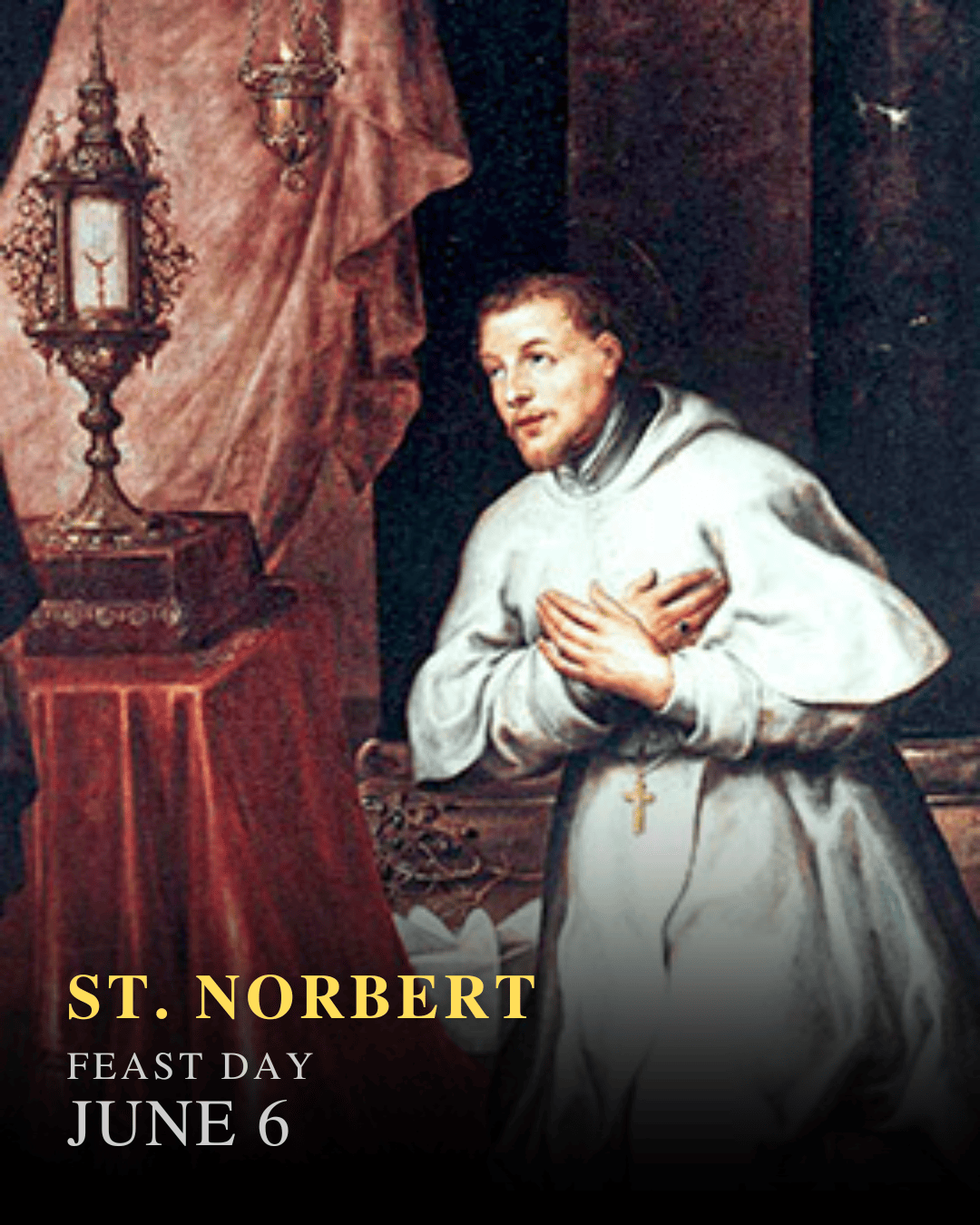
St. Norbert was born into a noble family in Germany and spent much of his early life surrounded by privilege, comfort, and opportunity. He served in the royal court and enjoyed a respected position in society. Like many people who become comfortable with worldly success, Norbert initially focused more on ambition and status than on deep spiritual commitment.
Everything began to change after a powerful conversion experience. According to tradition, Norbert was caught in a violent storm while riding on horseback. A lightning strike threw him to the ground, and the terrifying experience forced him to confront the direction of his life. He realized that God was calling him toward something greater and more meaningful.
After this experience, Norbert chose a very different path. He turned away from worldly comfort and dedicated himself to prayer, repentance, simplicity, and service to God. He eventually became a priest and devoted himself to preaching, reform, and spiritual renewal.
St. Norbert later founded the Norbertine Order, also known as the Premonstratensians. His religious community emphasized prayer, preaching, community life, service, and deep devotion to the Eucharist. Through his leadership and example, he helped renew the Church during a time when reform was urgently needed.
One of the most inspiring aspects of St. Norbert’s life is his conversion. He reminds us that no person is beyond the reach of God’s grace. Before his conversion, Norbert lived comfortably and did not fully embrace the spiritual life God desired for him.
Sometimes people imagine saints as individuals who were always holy from the beginning. Yet many saints experienced moments of awakening, repentance, and transformation. St. Norbert’s life demonstrates that conversion is possible when a person becomes open to God.
His near-death experience forced him to examine his priorities honestly. He realized that worldly success could not satisfy the deepest needs of the soul. Instead of ignoring this realization, he allowed it to change him.
Modern Catholics can learn an important lesson from this. God often uses unexpected moments to draw people closer to Himself. Difficult experiences, disappointments, fears, or seasons of uncertainty can become opportunities for spiritual renewal.
St. Norbert’s life shows that it is never too late to return to God. True conversion begins when we open our hearts to grace.
Norbert had a deep love for Christ in the Eucharist. He reminds Catholics to center their lives on the presence of Jesus in the Blessed Sacrament.
He guided others with courage and wisdom during times of spiritual weakness and reform. His leadership was rooted in service and holiness.
St. Norbert remained faithful despite resistance and challenges. His perseverance encourages us not to give up during difficult spiritual seasons.
After his conversion, Norbert made the difficult decision to leave behind the comfortable life he once enjoyed. This required humility and courage. Walking away from status and worldly security is not easy.
Many people today struggle with attachment to comfort, approval, success, or material security. St. Norbert’s example reminds us that earthly achievements alone cannot satisfy the soul.
This does not mean all Catholics must abandon their professions or responsibilities. Rather, Norbert challenges us to examine whether worldly priorities have taken God’s rightful place in our hearts.
Sometimes spiritual growth requires simplifying life, reevaluating priorities, or letting go of habits and distractions that pull us away from God.
St. Norbert eventually founded a religious community known as the Norbertines or Premonstratensians. The order combined contemplative prayer with active ministry and service.
The Norbertines were dedicated to living in community, praying together, celebrating the Eucharist, preaching, and serving the Church faithfully. Norbert wanted religious life to reflect both holiness and practical service.
His vision reflected balance. Prayer and action were not separated. Love for God naturally flowed into service toward others.
This balance remains important for Catholics today. Spiritual life should not become disconnected from daily responsibilities, and active service should not become separated from prayer.
One of the defining characteristics of St. Norbert’s spirituality was his deep devotion to the Eucharist. He believed strongly in the Real Presence of Christ and worked to strengthen reverence for the Blessed Sacrament.
During Norbert’s lifetime, there were debates and confusion regarding Eucharistic belief. He defended the truth of Christ’s presence with clarity and conviction.
His devotion reminds Catholics that the Eucharist is not merely symbolic. The Mass is the heart of Catholic life because Jesus truly gives Himself to us.
St. Norbert encourages Catholics to approach the Eucharist with reverence, gratitude, preparation, and love. Spending time in Eucharistic adoration, attending Mass faithfully, and receiving Communion with sincerity can deepen spiritual life profoundly.
St. Norbert lived during a time when parts of the Church needed renewal and reform. Some clergy had become spiritually careless, and discipline had weakened in certain areas.
Norbert worked courageously to encourage greater holiness, sincerity, and integrity within Church leadership. Reform was not always welcomed. He faced resistance, criticism, and opposition.
Yet Norbert understood that authentic renewal begins with holiness. Lasting reform cannot come only through rules or structures. It requires transformed hearts.
His example remains relevant today. The Church continues to need faithful Catholics who pray, serve, lead responsibly, and seek holiness with humility.
St. Norbert speaks powerfully to modern Catholics because many people today long for renewal, clarity, and deeper purpose. His life reminds us that God can transform even distracted or spiritually lukewarm hearts.
He teaches the importance of ongoing conversion. Becoming closer to God is not a one-time moment. Christians are continually invited to deeper trust, prayer, repentance, and holiness.
Norbert also reminds us to keep Christ at the center of life, especially through devotion to the Eucharist. In a culture full of distraction and noise, the Eucharist draws the soul back to what matters most.
Finally, his witness encourages faithful leadership rooted in service rather than pride. Whether in families, parishes, ministries, or workplaces, leadership becomes holy when it helps others move closer to God.
One practical way to imitate St. Norbert is to examine your spiritual priorities honestly. Ask whether God truly holds first place in your life or whether distractions and worldly concerns are becoming more important.
Another way is to deepen devotion to the Eucharist. Attending Mass faithfully, spending time in adoration, preparing carefully for Communion, and praying before the Blessed Sacrament can strengthen spiritual life.
His example also encourages ongoing conversion. Spiritual growth requires humility and willingness to change. Catholics are invited to return to God repeatedly through prayer, repentance, and trust.
Finally, St. Norbert teaches the importance of balancing prayer and action. Service becomes stronger when rooted in prayer, and prayer becomes fruitful when it shapes daily life.
St. Norbert’s life reminds us that God can completely transform a human heart. His journey from worldly comfort to holiness shows the power of grace when a person responds sincerely.
His devotion to the Eucharist also highlights the central place of Christ in Catholic life. In every age, the Church is renewed when believers return to Jesus with reverence and love.
For anyone seeking spiritual renewal, purpose, or a deeper relationship with God, St. Norbert offers a powerful example of conversion, surrender, and faithful leadership.
You may also deepen your prayer life through our Morning Prayer and Evening Prayer pages. Daily prayer helps the heart remain open to God’s grace and guidance.
“St. Norbert, help me turn back to God, live with devotion, and follow Christ with a renewed heart.”
— Prayer inspired by the life of St. Norbert