St. Boniface
Missionary Bishop and Apostle of Germany
c. 675–754
Missionary Bishop and Apostle of Germany
c. 675–754
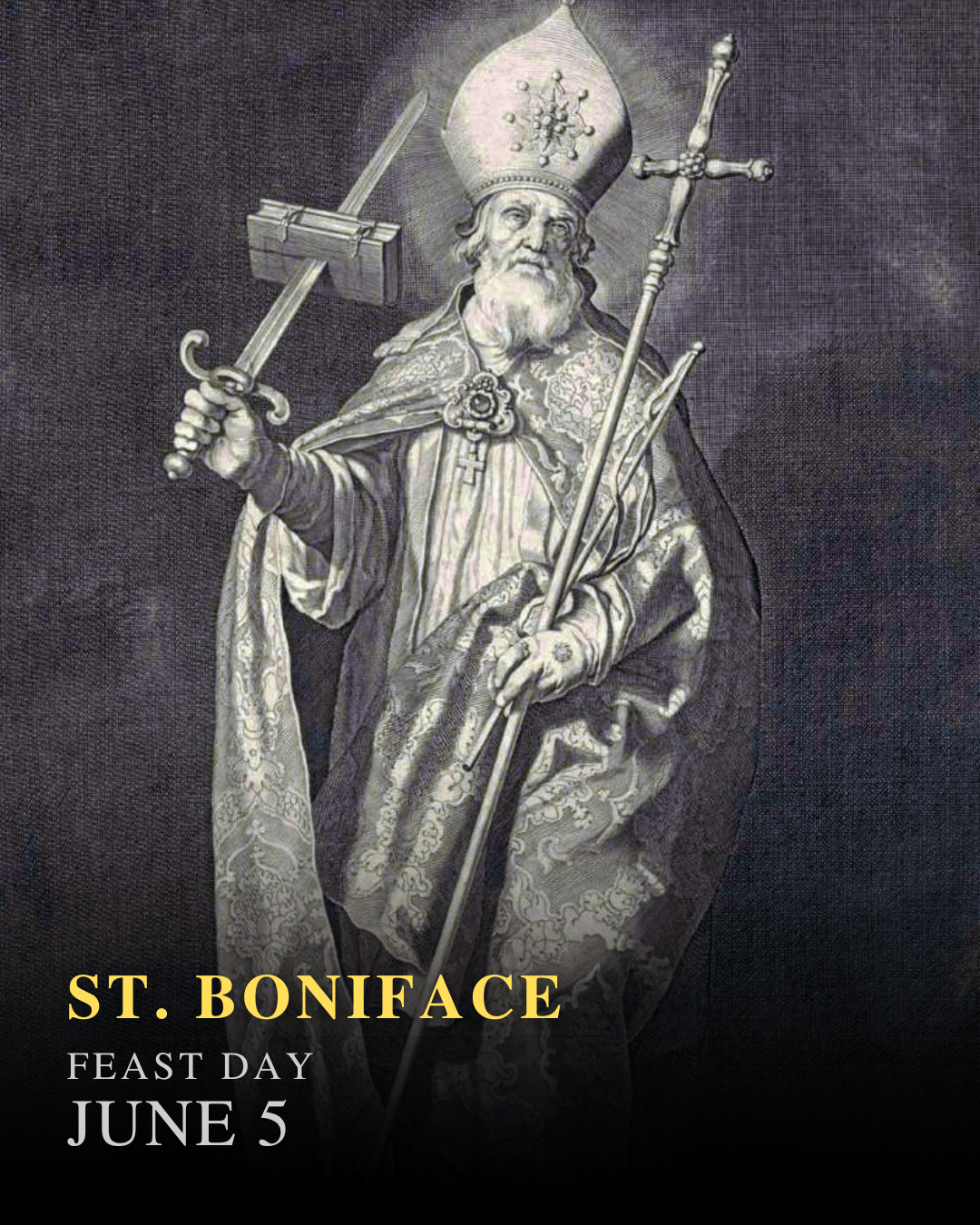
St. Boniface was an English monk who became one of the greatest missionaries in the history of the Church. He is often called the Apostle of Germany because of his tireless efforts to spread Christianity and strengthen the Church in regions where the faith was still growing. His life was marked by courage, missionary zeal, leadership, and deep trust in God.
From a young age, Boniface felt drawn toward religious life. He entered a monastery where he devoted himself to prayer, study, teaching, and Scripture. Although he lived a stable and respected monastic life, he sensed that God was calling him toward something more demanding. Instead of remaining comfortable, he chose to leave his homeland and become a missionary.
Boniface traveled throughout parts of Europe, especially in what is now Germany, preaching the Gospel, baptizing converts, organizing Christian communities, and strengthening Church leadership. His work helped establish deeper unity and stability within the Church.
He is especially remembered for his fearless witness. One famous story tells how he cut down a sacred tree used in pagan worship. When the people saw that their false gods did not strike him down, many became open to hearing about Christ. Boniface’s courage helped lead countless people toward Christianity.
One of the most inspiring parts of St. Boniface’s story is his willingness to leave comfort behind in order to follow God’s call. He already had a meaningful life as a monk, teacher, and scholar. Yet he believed God was asking him to serve in more difficult missionary work.
This decision required courage. Missionary journeys during his time were dangerous and uncertain. Travel was difficult, communication was limited, and many regions were hostile to Christianity. Boniface could not rely on safety or convenience.
His example reminds modern Catholics that discipleship sometimes requires stepping outside familiar routines. God may call people toward difficult conversations, new responsibilities, service opportunities, or deeper forms of trust.
Many people feel spiritually comfortable remaining where life feels predictable. St. Boniface challenges us to ask whether fear is preventing us from responding generously to God’s invitations.
St. Boniface left his homeland to bring the Gospel to others. His example encourages Catholics to share their faith with courage, love, and conviction.
Boniface faced danger and opposition without abandoning his mission. He reminds us to trust God even during uncertain situations.
He helped organize Christian communities and strengthen the Church. His life teaches that leadership should be rooted in service and faithfulness.
Despite challenges and resistance, Boniface continued preaching and serving faithfully. His perseverance teaches us not to give up when spiritual work becomes difficult.
St. Boniface became known as the Apostle of Germany because of the extraordinary impact of his missionary work. He traveled widely through regions where Christianity was still weak or mixed with pagan practices.
His mission was not simply about increasing numbers of converts. Boniface worked carefully to build stable Christian communities rooted in authentic teaching and sacramental life. He established monasteries, organized dioceses, trained clergy, and strengthened unity with the Church in Rome.
His work reminds Catholics that evangelization involves more than speaking about faith. It also involves building strong spiritual foundations, forming disciples, and helping communities remain rooted in truth.
Boniface understood that lasting spiritual renewal requires patience and structure. His leadership combined missionary passion with practical wisdom.
One of the most famous stories about St. Boniface involves a sacred oak tree dedicated to a pagan god. The local people believed the tree held spiritual power and feared that anyone who harmed it would face divine punishment.
Boniface boldly cut down the tree to demonstrate that false gods had no power over Christ. According to tradition, when nothing happened to him, many people realized the emptiness of pagan worship and became more open to Christianity.
This event was not simply about destroying a tree. It symbolized the courage required to confront false beliefs and lead people toward truth.
Modern Catholics may not face pagan shrines in the same way, but there are still false idols today. Wealth, popularity, power, comfort, pleasure, and self-centered living can quietly take the place of God in human hearts. St. Boniface reminds us to examine what truly holds first place in our lives.
St. Boniface was not only a missionary preacher. He was also a wise leader who understood the importance of building and strengthening the Church.
He worked to improve discipline among clergy, encourage unity, and support healthy Christian communities. Leadership for Boniface was never about personal status. It was about responsibility, service, and care for souls.
This offers an important lesson today. Many people think leadership means influence, recognition, or authority. Christian leadership looks different. It is rooted in humility and sacrifice.
Parents, teachers, parish leaders, catechists, and mentors all have opportunities to lead others spiritually. Sometimes leadership appears quietly through consistent faithfulness, good example, patience, and encouragement.
Even late in life, St. Boniface continued traveling on missionary journeys. He remained committed to preaching the Gospel despite increasing danger.
Eventually, while preparing converts for Confirmation, Boniface and several companions were attacked and killed. According to tradition, he faced death holding the Gospel book rather than defending himself with violence.
His martyrdom reveals the depth of his love for Christ. Boniface did not simply speak about faith. He remained faithful until the end.
The witness of martyrs reminds Catholics that Christianity is not merely a cultural identity. It is a relationship with Christ worth giving everything for.
St. Boniface speaks powerfully to modern Catholics because many people today struggle with fear, comfort, and silence regarding faith. His life reminds us that Christianity is meant to be lived publicly and courageously.
He teaches the importance of evangelization. Sharing faith does not always require formal preaching. It can happen through conversations, acts of kindness, faithful parenting, parish involvement, or simply living differently from the surrounding culture.
Boniface also reminds us that spiritual renewal takes patience and perseverance. Building strong faith in families, communities, and parishes often happens gradually.
Finally, his witness challenges Catholics to examine what false idols may exist in modern life. Anything that takes God’s rightful place in our hearts can become spiritually dangerous.
One practical way to imitate St. Boniface is to practice courage in sharing your faith. This may involve speaking honestly about Christian values, inviting someone to Mass, praying publicly before meals, or encouraging another person spiritually.
Another way is to examine what holds the greatest influence in your heart. Boniface confronted false worship directly. Catholics today can ask whether comfort, success, social approval, or distraction are becoming more important than God.
His example also encourages perseverance. Spiritual growth and evangelization often require patience. Results may not appear immediately, but faithful effort matters deeply.
Finally, Catholics can imitate Boniface by supporting the Church through prayer, service, teaching, leadership, and encouragement within their own communities.
St. Boniface’s life reminds us that faith is meant to be shared boldly and faithfully. He did not keep his relationship with God private or passive. Instead, he dedicated his entire life to bringing others closer to Christ.
His witness also shows that courage often becomes necessary when living authentically as a Christian. Following Christ may require stepping into uncomfortable or unfamiliar situations.
For anyone called to leadership, evangelization, teaching, or missionary work, St. Boniface offers a powerful example. He shows that when we trust God completely, our lives can bear spiritual fruit far beyond what we imagine.
You may also deepen your prayer life through our Morning Prayer and Evening Prayer pages. Daily prayer strengthens courage and helps the heart remain rooted in Christ.
“St. Boniface, help me share the Gospel with courage and live my faith with conviction.”
— Prayer inspired by the life of St. Boniface