St. Bede the Venerable
Doctor of the Church and Faithful Scholar
c. 673–735
Doctor of the Church and Faithful Scholar
c. 673–735
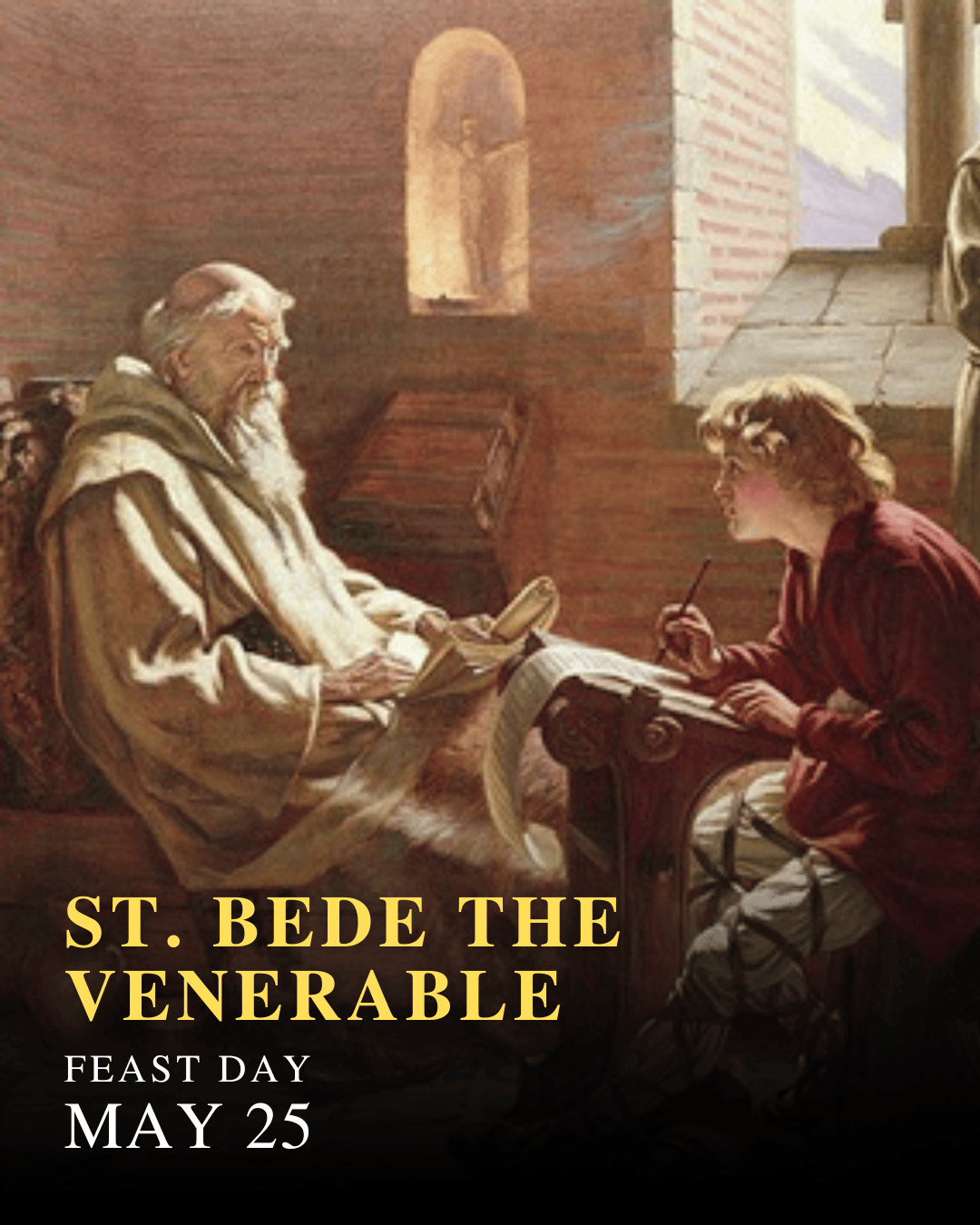
St. Bede the Venerable was an English monk, priest, scholar, historian, and Doctor of the Church whose life shows that learning can become a path to holiness when it is rooted in love for God. He was born around the year 673 in northern England and spent most of his life in the monastery of Wearmouth-Jarrow. From a young age, he was given to monastic life, where prayer, study, Scripture, and community shaped his heart and mind.
Bede is remembered for his extraordinary scholarship, but he was not simply a man who collected information. His learning was ordered toward God. He studied Scripture, theology, history, grammar, science, poetry, and the life of the Church because he believed truth ultimately leads the soul closer to the Lord. His writings helped preserve Christian history and teaching, especially the story of the early Church in England.
He is best known for his historical work, often called the Ecclesiastical History of the English People, but his contribution went far beyond history. He wrote biblical commentaries, taught monks and students, explained the faith, and helped others understand the richness of Christian tradition. In an age when books were rare and learning required patience, discipline, and sacrifice, Bede dedicated his whole life to study, prayer, and service.
Despite his great knowledge, St. Bede remained humble. He did not study to impress others or to make himself important. He studied because he loved God and wanted to serve the Church. His life reminds us that the mind is also meant for holiness. We are called to love God not only with our hearts and actions, but also with our understanding.
St. Bede’s life was rooted in the rhythm of monastic prayer. The monastery was not merely a place where he worked. It was the spiritual home where his soul was formed. The daily pattern of prayer, chanting the Psalms, listening to Scripture, studying sacred texts, and living in community shaped everything he did. His scholarship cannot be separated from his prayer life.
This is important because knowledge by itself can become dry, proud, or restless. Bede’s learning was different because it was nourished by humility and worship. He approached Scripture not as a puzzle to master, but as the living Word of God to receive with reverence. He wanted to understand so that he could love more deeply and teach more faithfully.
Many people today separate faith and learning, as if devotion belongs only to the heart and study belongs only to the mind. St. Bede shows a better way. He teaches that faith and reason can work together beautifully. Study can become prayer when it is done with humility. Reading can become a form of discipleship when it leads us closer to truth. Teaching can become service when it helps others know God.
His life is especially encouraging for students, teachers, writers, catechists, homeschool parents, ministry leaders, and anyone who wants to understand the faith more deeply. Bede reminds us that learning is not wasted when it is offered to God. Every effort to know truth can become part of our spiritual growth.
St. Bede sought truth through prayerful study. He teaches us that wisdom is more than information. It is the ability to see life in light of God and order our hearts toward Him.
He remained humble despite his great knowledge. He reminds us that all wisdom comes from God and that learning should make us more grateful, not more prideful.
He lived a consistent life of prayer, study, and service in the monastery. His example encourages us to remain devoted in the ordinary routines of daily life.
He deeply studied God’s Word and helped others understand it. He shows us that Scripture should be approached with reverence, patience, and a desire to know Christ.
St. Bede is commonly called “the Venerable,” a title of deep respect. It reflects the honor given to his holiness, learning, and faithful service to the Church. The title does not mean he was distant or unreachable. It means that his life inspired reverence because he used his gifts for God’s glory.
His holiness was not dramatic in the way some saints are remembered for martyrdom, miracles, or missionary journeys across distant lands. Instead, Bede’s holiness was steady. It was formed in the quiet discipline of monastic life. He prayed, studied, wrote, taught, and remained faithful. This kind of holiness may seem ordinary from the outside, but it can be deeply powerful.
Many people need this reminder. Not every saintly life looks exciting or public. Some lives become holy through consistency, careful work, patience, and love in hidden places. A mother teaching her child to pray, a student studying faithfully, a teacher preparing lessons, a writer choosing truth, or a person reading Scripture each morning can all live a kind of hidden fidelity that matters to God.
St. Bede’s title also reminds us to treat the life of the mind with reverence. Words matter. Teaching matters. History matters. Scripture matters. What we read and learn can shape the soul. Bede used his mind as an offering to God, and that is why his memory has endured for centuries.
St. Bede is honored as a Doctor of the Church, a title given to saints whose teaching has special importance for the whole Church. Doctors of the Church are recognized not only for holiness, but also for the depth and usefulness of their teaching. Bede’s writings helped preserve faith, explain Scripture, and pass on Christian history to later generations.
His work mattered because he helped people remember. Memory is important in the Christian life. The Church is not built on passing trends or private opinions. It is rooted in the saving work of God through history. Bede helped preserve the story of how the Gospel took root in England, how saints and missionaries served, and how the Church grew in faith.
His title as Doctor of the Church also shows that scholarship can be an act of service. Bede’s writings were not meant to make him famous. They were meant to help others understand truth. Good Catholic teaching should always do this. It should clarify, strengthen, encourage, and lead souls closer to Christ.
In a world filled with quick opinions and shallow information, Bede’s example is especially needed. He teaches patience, careful thought, and reverence for truth. He reminds us that learning the faith deeply is not only for priests, scholars, or theologians. Every Catholic can grow in understanding and love for God.
St. Bede had a deep love for Scripture. He spent much of his life reading, explaining, and commenting on the Word of God. He approached the Bible with faith, reverence, and careful attention. He did not treat Scripture as merely an academic text. He received it as God’s Word given to nourish, guide, correct, and sanctify the soul.
His example is helpful for anyone who wants to read the Bible but feels overwhelmed. Scripture can sometimes seem difficult, especially when passages are unfamiliar or hard to understand. St. Bede reminds us that understanding grows over time. We do not need to grasp everything at once. We can begin with prayer, patience, and a willingness to learn.
One simple way to follow his example is to read Scripture slowly. Instead of rushing, choose a short passage and ask: What does this reveal about God? What does it reveal about the human heart? What is God inviting me to trust, change, or receive? This kind of prayerful reading can help Scripture move from the page into daily life.
St. Bede also teaches that Scripture should be read within the life of the Church. Catholic interpretation is not isolated from tradition, worship, and the community of faith. The same Church that preserved and proclaimed Scripture helps us understand it faithfully.
St. Bede’s life beautifully unites faith and learning. He shows that intellectual work is not opposed to holiness. When study is guided by humility, it can become a way of loving God. This matters because some people feel that asking questions or seeking understanding is somehow a lack of faith. Bede shows that faithful study can deepen belief rather than weaken it.
At the same time, Bede also shows that knowledge must be purified by love. Learning can become prideful if it is separated from humility. A person can know many things and still lack wisdom. Bede’s greatness was not only that he knew much, but that he placed his knowledge at the service of God and the Church.
This lesson is important for modern Catholics. We live in a time of abundant information, but information alone does not form the soul. We need wisdom. We need discernment. We need the grace to know what is true, good, and holy. St. Bede invites us to become thoughtful Christians whose minds are formed by faith.
For Catholic women especially, this can be a meaningful encouragement. Studying the faith, reading Scripture, learning Church history, and teaching children or others are holy works. The mind is not separate from discipleship. Loving God with the mind can strengthen the heart and shape daily life.
One lesson from St. Bede is that ordinary faithfulness can bear lasting fruit. He spent most of his life in one place, within the monastery. He did not need constant movement or public attention to serve God. His hidden discipline shaped generations. This is comforting for anyone whose life feels small, repetitive, or unnoticed.
A second lesson is that learning should lead to worship. Bede’s study did not make him cold or detached. It led him deeper into reverence. True knowledge of God should make us more humble, more prayerful, and more loving. If learning makes us proud or impatient with others, something is missing.
A third lesson is that history matters. Bede preserved stories of faith because he understood that Christians need memory. Remembering the lives of saints, the growth of the Church, and the works of God helps us live with gratitude and identity. We are part of a larger story that began long before us.
Finally, Bede teaches perseverance. Writing, teaching, copying, praying, and studying require patience. Spiritual growth also requires patience. We become holy not only through big moments, but through daily acts of fidelity repeated with love.
You can ask St. Bede the Venerable to pray for you when you want to grow in wisdom, understand Scripture more deeply, study the faith, teach others, or use your gifts for God’s glory. He is a helpful intercessor for students, teachers, writers, scholars, catechists, parents, and anyone who wants to love God with both heart and mind.
If you struggle with distraction in prayer or study, ask St. Bede to help you become more patient. If you feel intimidated by Scripture, ask him to help you approach God’s Word with humility. If you teach others, ask him to help you teach truth clearly and lovingly. If you write, research, or create, ask him to help you use your words in service of what is good.
His intercession can also be helpful for families. Parents who teach the faith at home often need wisdom, patience, and clarity. St. Bede reminds us that passing on faith is a beautiful work, even when it happens in simple conversations, bedtime prayers, or small lessons repeated over time.
You may also deepen your spiritual life through our Morning Prayer, Evening Prayer, and Healing Prayer pages. For more examples of faithful teachers and Doctors of the Church, you may enjoy reading about St. John of Avila, St. Bernardine of Siena, and St. Thomas Aquinas.
St. Bede the Venerable reminds us that learning and faith go together. His life shows that studying God’s truth can draw us closer to Him when study is rooted in prayer, humility, and love. He did not separate intellectual work from spiritual life. He made his mind an offering to God.
Like St. Bernardine of Siena and St. John of Avila, he used knowledge to guide others in faith. His example encourages us to seek truth, grow spiritually, and remain faithful in both mind and heart.
His witness also reminds us that holiness can be quiet and steady. A faithful life of prayer, study, teaching, and service can influence generations. We may not see the full fruit of our work, but God can use small acts of faithfulness in lasting ways.
St. Bede invites us to love God with our whole being, including our minds. He encourages us to read Scripture, study the faith, remember the history of the Church, and seek wisdom that leads to holiness.
“St. Bede, help me to seek truth, grow in wisdom, and remain faithful to God.”
— Prayer inspired by his life