Most Holy Trinity
One God in Three Divine Persons
Eternal Mystery
One God in Three Divine Persons
Eternal Mystery
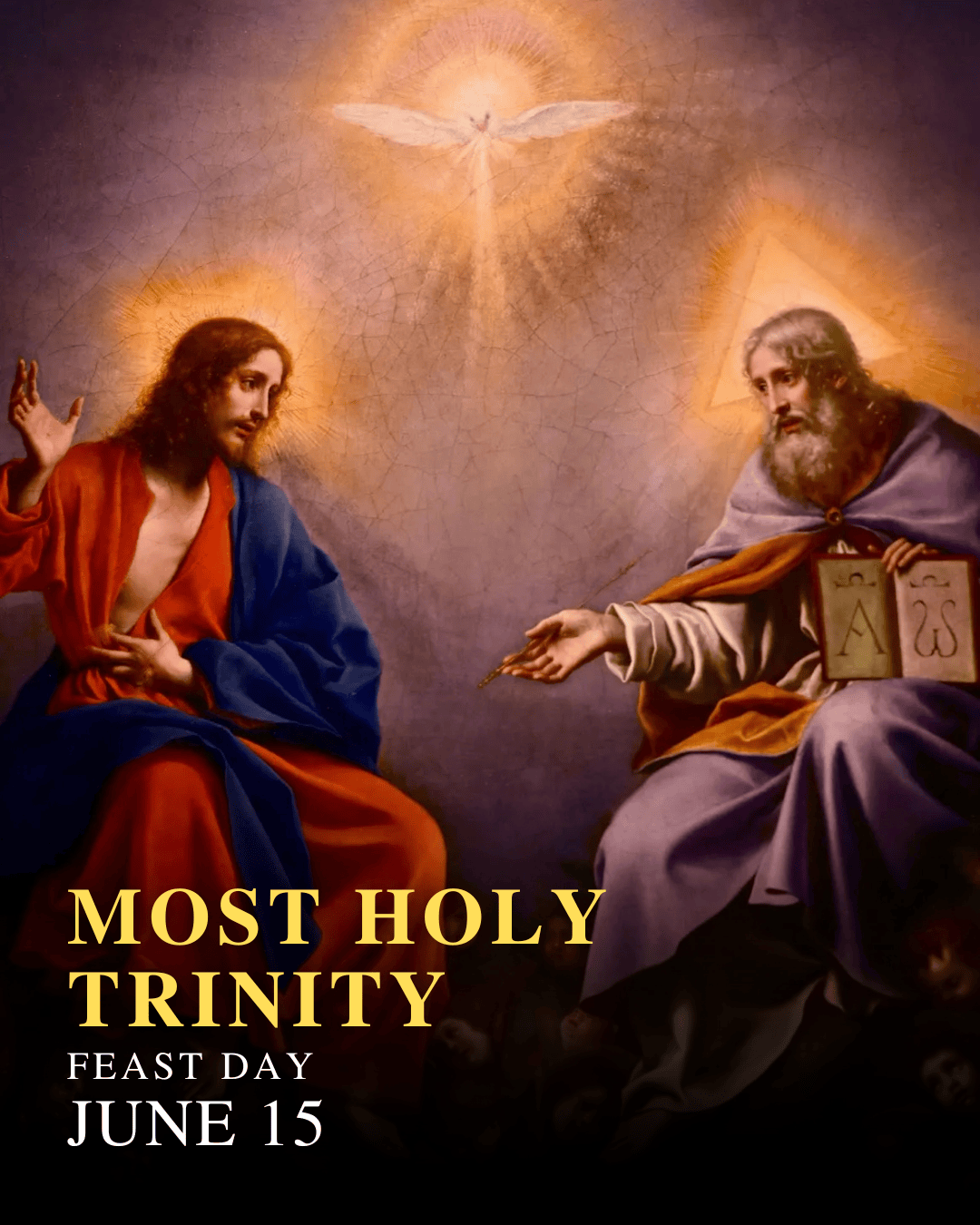
The Most Holy Trinity is the central mystery of the Christian faith. Catholics believe in one God in three Divine Persons: the Father, the Son, and the Holy Spirit. This does not mean that Christians believe in three gods. It also does not mean that God is one Person simply appearing in three different forms. The Trinity means that God is one in nature and three in Persons, a perfect communion of love that has always existed and will always exist.
This mystery is beyond what the human mind can fully explain. Even the greatest saints, theologians, and teachers of the Church have approached the Trinity with humility. We can speak truthfully about the Trinity because God has revealed Himself, but we cannot reduce Him to something small enough to fit inside our complete understanding. The Trinity is not a puzzle to solve. It is the mystery of who God is.
The Father is the source of all creation. The Son is the eternal Word of God who became man in Jesus Christ for our salvation. The Holy Spirit is the Lord and giver of life, poured into our hearts to sanctify, guide, and strengthen us. The Father, Son, and Holy Spirit are distinct Persons, yet perfectly one God. They are never divided in love, will, holiness, or purpose.
The Trinity can sound like a doctrine that belongs only in catechism books or theology classes, but it is deeply personal. The Trinity tells us that God is not loneliness. God is not isolation. God is eternal love. Before creation existed, before angels, saints, churches, families, or human history, God already existed as perfect communion: Father, Son, and Holy Spirit. Love is not something God learned after creating the world. Love is who God is.
This matters because it changes how we understand ourselves. If we are made in the image and likeness of God, and God is communion, then we are made for relationship. We are not created to live closed in on ourselves. We are made to love God and to love others. The longing in the human heart for belonging, tenderness, friendship, family, mercy, and communion points back to the God who created us.
The Trinity also helps us understand why love must be more than emotion. Within the life of the Trinity, love is total self-gift. The Father gives. The Son receives and gives Himself completely. The Holy Spirit is the bond of love. This eternal exchange of love reveals that true love is generous, faithful, fruitful, and self-giving. It is not selfish possession. It is not convenience. It is not simply warm feeling. It is the gift of self.
For Catholic women, this truth can touch everyday life in very practical ways. The Trinity teaches us that the hidden acts of love in a home, marriage, friendship, parish, workplace, or caregiving role matter. Cooking a meal, forgiving a harsh word, praying for a child, listening patiently, serving an elderly parent, or choosing peace instead of pride can become small reflections of divine love. We are invited to let the life of the Trinity shape the ordinary rhythm of our days.
The Trinity shows that God is not isolated. He exists in perfect relationship. This invites us to value holy connection, family, friendship, community, and communion with the Church. We are not meant to become self-sufficient in a cold or lonely way. We are made to receive love and to give love.
Father, Son, and Holy Spirit are perfectly united. Their unity calls us to seek peace in our relationships, avoid unnecessary division, and work toward healing where sin, pride, or misunderstanding has wounded love.
At the center of the Trinity is love. This reminds us that love is not optional in the Christian life. It is the foundation of everything: prayer, family life, service, forgiveness, sacrifice, and holiness.
The Trinity teaches us to approach God with reverence. Not everything about God can be mastered by the human mind. Humility allows us to believe, adore, and trust even when mystery remains.
The Trinity is present every time we make the Sign of the Cross. When Catholics say, “In the name of the Father, and of the Son, and of the Holy Spirit,” we are not merely beginning a prayer with familiar words. We are placing ourselves before the living God. We are remembering our baptism. We are marking ourselves with the mystery of God’s life and love.
This simple prayer is one of the first prayers many Catholic children learn, but it never becomes childish. It is simple enough for a child and deep enough for a saint. The Sign of the Cross reminds us that our whole life belongs to God. Our thoughts, words, actions, suffering, work, family, and hidden sacrifices can all be offered to the Father, through the Son, in the Holy Spirit.
The Trinity also shapes the way the Church prays at Mass. The Mass is offered to the Father, through Christ the Son, in the unity of the Holy Spirit. This means that Catholic worship is not just a gathering of people thinking about God. It is participation in the prayer of Christ. We are drawn into the Son’s offering to the Father, and the Holy Spirit makes that worship living and fruitful within the Church.
In personal prayer, the Trinity can help us pray more deeply. We can come to the Father as beloved children. We can speak to Jesus as our Savior, Lord, Bridegroom, and Friend. We can ask the Holy Spirit to guide, strengthen, purify, and console us. Prayer becomes less like talking into emptiness and more like entering a relationship of love that already exists and is already reaching toward us.
The Father is the Creator and source of all life. Everything we have begins in His goodness. Our existence is not random or accidental. We are created because God wills us to exist. This truth can bring deep comfort, especially to anyone who struggles with feeling unseen, unwanted, or without purpose. The Father knows each soul personally. He does not create by accident.
To believe in God the Father is to believe that life has meaning. We are not simply products of circumstance, background, success, beauty, failure, or public opinion. Our dignity comes from being created by God. This is why every human life has value, from the unborn child to the elderly, from the healthy to the sick, from the confident to the wounded.
The Father’s love also teaches us how to receive. Many people find it easier to serve than to be loved. Some carry wounds from earthly fathers, broken families, rejection, or disappointment. The Fatherhood of God does not erase those wounds instantly, but it reveals a love that is steady, holy, and trustworthy. The Father is not distant indifference. He is the source of mercy and life.
Reflecting on the Father can help a Catholic woman rest in her identity as a beloved daughter. Before she is a mother, wife, worker, friend, caregiver, leader, or helper, she is loved by God. That identity is not earned by performance. It is received as grace.
The Son is the eternal Word of God who became man in Jesus Christ. Through the Incarnation, God did not remain distant from human suffering. Jesus entered our world, took on our flesh, lived among us, taught us, healed the sick, welcomed sinners, suffered, died, and rose again. The Son reveals the face of the Father and opens the way to salvation.
Through Jesus, we learn that God’s love is not vague. It is concrete. It has a face, a voice, wounds, a cross, and a resurrection. Jesus shows us what divine love looks like when it enters human history. He seeks the lost, forgives the repentant, strengthens the weak, and gives Himself completely.
The Son also teaches us how to live as children of the Father. Jesus lives in perfect obedience and love. His obedience is not cold or forced. It is filial trust. He shows us that holiness means surrendering our will to God, not because God wants to crush us, but because God’s will leads to life.
For everyday life, this means we can bring everything to Jesus. We can bring Him our sins, fears, family concerns, grief, disappointments, hopes, and questions. He is not unfamiliar with human pain. He has entered it and redeemed it. In Christ, suffering is no longer meaningless when united to Him.
The Holy Spirit is the Lord and giver of life. He is not merely a symbol of inspiration or emotion. He is God. The Holy Spirit dwells in the Church and in the souls of the baptized. He strengthens faith, gives grace, convicts the heart, consoles the sorrowful, and helps us become holy.
Many Catholics know they should pray to the Father and to Jesus, but they sometimes forget to call upon the Holy Spirit. Yet the Holy Spirit is the One who helps us pray when we do not know how to pray. He brings light to confusion, courage to weakness, and peace to troubled hearts. He gives the gifts needed for the Christian life.
In daily life, asking the Holy Spirit for help can be very practical. Before answering a difficult message, we can pray, “Holy Spirit, guide my words.” Before making a decision, we can pray, “Holy Spirit, give me wisdom.” When we feel spiritually dry, we can pray, “Holy Spirit, renew my heart.” These simple prayers open space for grace.
The Holy Spirit also forms unity. Where pride divides, He teaches humility. Where bitterness hardens the heart, He invites forgiveness. Where fear keeps us silent, He gives courage. The Spirit helps us live as members of the Body of Christ instead of isolated individuals trying to follow God alone.
The mystery of the Trinity is not meant to stay only in our minds. It is meant to shape the way we live. If God is communion, then love must become the pattern of Christian life. This begins with prayer, but it also moves into the way we speak, serve, forgive, and make decisions.
In family life, the Trinity invites us to practice self-giving love. This does not mean ignoring healthy boundaries or pretending that difficult relationships are easy. It means asking how love can be faithful, truthful, patient, and generous. A home shaped by the Trinity is not a perfect home without conflict. It is a home where people keep returning to mercy, prayer, and unity.
In friendships and parish life, the Trinity calls us away from gossip, rivalry, and unnecessary division. Unity does not mean everyone has the same personality or opinion. It means that charity remains stronger than pride. The Father, Son, and Holy Spirit are perfectly united without confusion or competition. This can teach us how to honor difference without destroying communion.
In personal identity, the Trinity reminds us that we are created, redeemed, and sanctified. We are created by the Father, redeemed by the Son, and guided by the Holy Spirit. This truth gives life a foundation deeper than mood, success, failure, or other people’s approval. A woman rooted in the Trinity knows she is loved, saved, and never abandoned.
The mystery of the Trinity may seem complex, but its meaning is very personal. It tells us that we are created for relationship. Human life makes more sense when we understand that we are not meant to live alone or independently. We are made to love and to be loved.
The Trinity also shapes how we pray. When we pray, we often begin in the name of the Father, and of the Son, and of the Holy Spirit. This is not just a formula. It is a reminder that we are entering into the life of God. Prayer becomes a relationship rather than just a request.
Many people struggle with the idea of God being distant. The Trinity shows the opposite. God is deeply involved. The Father creates and sustains us. The Son enters into our human experience. The Holy Spirit remains with us, guiding and strengthening us.
This devotion also helps us understand love in a deeper way. Love is not simply a feeling. It is a constant giving of self. Within the Trinity, each Person gives fully. There is no selfishness. This becomes a model for how we are called to live.
In daily life, this can be lived out in simple ways. Choosing patience when it is difficult. Listening instead of reacting. Giving time and attention to others. Asking forgiveness. Making peace. Choosing prayer before worry. These small actions reflect the life of the Trinity more than we might realize.
The Trinity also invites us to trust. Even when life feels confusing, we are held within a relationship of perfect love. We are not outside of God’s care. We are part of His plan.
Another important aspect is identity. Knowing that we are created by the Father, redeemed by the Son, and guided by the Holy Spirit gives us a sense of purpose. It reminds us that our lives have meaning beyond what we can see.
This solemnity is also a moment to reflect on how we live our faith. Do we treat it as something separate from daily life, or do we allow it to shape everything we do? The Trinity calls us to integration. Faith is not one part of life. It is the foundation of it.
The more we reflect on the Trinity, the more we begin to see that it is not meant to be solved like a problem. It is meant to be entered into. It is an invitation to live in relationship with God every day.
Over time, this changes how we see everything. Work becomes a place of service. Relationships become opportunities for love. Challenges become moments of trust. The Trinity becomes the lens through which we understand life.
This is why the Church places such importance on this solemnity. It is not only about understanding God. It is about understanding who we are and how we are meant to live.
“Holy Trinity, guide my life, deepen my faith, and teach me to live in love.”
— Traditional prayer