If you grew up praying the Hail Holy Queen or saying the Rosary, you have probably called Mary "Queen" more times than you can count without ever stopping to ask where that title actually comes from.
It is easy to assume it is just a nice, poetic way of honoring her. But the Church does not hand out titles lightly, and the title of Queen has real theological roots behind it.
Understanding where it comes from can make the words we already say so often feel a lot less routine and a lot more meaningful.
The simple answer: Mary is called Queen because her Son, Jesus Christ, is King. Her queenship comes entirely from her relationship with Him.
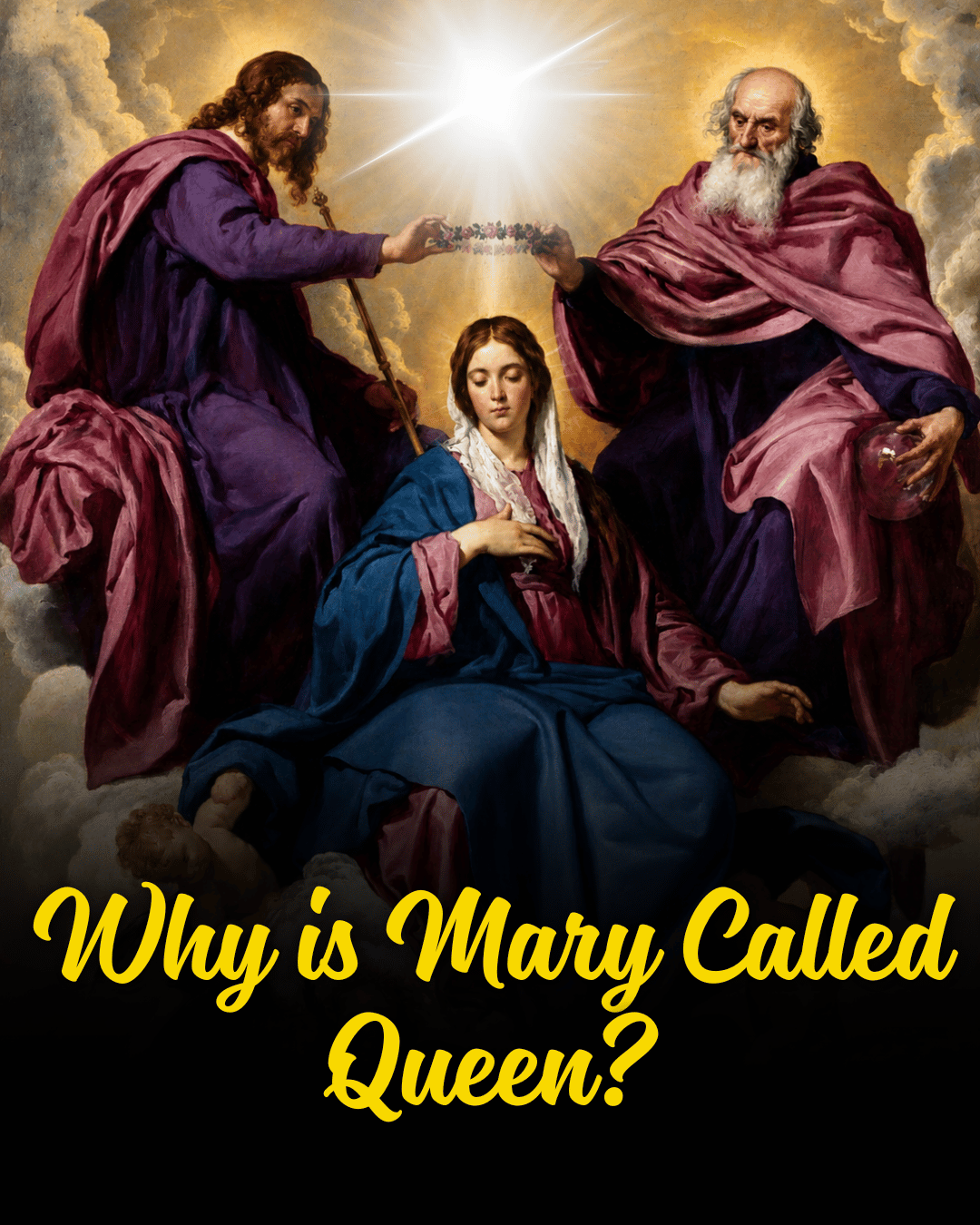
Mary's queenship is rooted in her relationship with Jesus, the eternal King.
It Starts With Her Son Being King
The most basic reason Mary is called Queen is simple. Her Son is King.
Scripture repeatedly describes Jesus as a king in the line of David, the one who would reign forever. The angel Gabriel says as much to Mary at the Annunciation, telling her that her son will be given the throne of his father David and that his kingdom will never end.
This is important because Jesus is not simply being given a temporary royal title. He is the promised Messiah and the eternal King whose kingdom has no end.
If Jesus is King, the natural next question is what that makes His mother. And this is where a very old, very Jewish tradition comes into the picture.
The Queen Mother of the Old Testament
In the ancient kingdom of Judah, kingship worked differently than we might assume. The king often had multiple wives, so the title of queen did not automatically go to a wife.
Instead, it went to the king's mother. She held an official position in the royal court called the gebirah, which is usually translated as queen mother.
This was not just a ceremonial title either. The queen mother had a genuine place of honor in the royal court and could bring requests to the king.
One clear example appears in the First Book of Kings. Bathsheba, the mother of King Solomon, approaches her son with a request on behalf of someone else. Solomon has a throne brought out for her, and she sits at his right hand.
This gives us an important picture of what the queen mother's role could look like. She was not the king's equal, nor did she rule instead of him. But she held an honored place because she was his mother.
A Place of Honor
The king's mother held a recognized and honored position within the royal court.
The King's Mother
The queen mother was honored because of her relationship to the king, not because she was the king herself.
Bringing Requests
The queen mother could approach the king with requests, giving us a helpful picture for understanding Mary's intercession.
Relationship Matters
Her position came from her relationship with the king. This helps us understand why Mary's queenship is completely connected to Jesus.
How This Points to Mary
Early Christians, many of whom were steeped in this Jewish tradition, naturally connected the dots. If Jesus is the eternal King in the line of David, then His mother holds the role of Queen Mother in His kingdom.
Not because she demanded it, and not because she rules alongside Him as an equal, but because of who she is in relation to Him.
This is really the heart of the answer. Mary's queenship is not about power in the way we usually think of royal power. It is relational.
It exists because of her closeness to Christ, first as the woman who carried Him and raised Him, and then as the one who remained faithful to Him all the way to the cross.
Her authority, if we can even call it that, looks like the queen mother's role in the Old Testament court. She is someone people can bring their needs to, trusting that she will carry those needs to her Son, and that He will listen to her the way a son listens to a mother he loves.
Think About the Hail Holy Queen
When Catholics call Mary "our life, our sweetness, and our hope," they are not treating her as a replacement for Jesus. They are turning to the mother of Christ and asking her to pray for us as she leads us toward her Son.
A Title That Grew Over Centuries
Devotion to Mary as Queen is not a modern invention. Early Church writers referred to her this way as far back as the fourth and fifth centuries.
Over time, this belief became woven into the Church's prayer life, showing up in ancient hymns, in the Rosary, and eventually in Marian art, where Mary is often depicted being crowned by the Holy Trinity.
The title became especially familiar through Catholic prayers such as the Salve Regina, or Hail Holy Queen, which has been part of the Church's prayer tradition for centuries.
In 1954, Pope Pius XII gave this long-standing belief a formal place on the liturgical calendar by establishing the Feast of the Queenship of Mary, celebrated on August 22nd.
He was not introducing something completely new. Rather, the feast gave formal liturgical recognition to a devotion and belief that had already been present in the life and prayer of the Church for centuries.
What This Title Is Not
It is worth clearing up a common misunderstanding here. Calling Mary Queen does not mean Catholics believe she has divine power of her own, or that she is somehow equal to God.
Her queenship is entirely dependent on her Son. She reigns because she is His mother, not because she possesses authority independent of Him.
Catholics worship God alone. Mary is honored because of God's grace in her life and because of her unique relationship with Jesus.
Keep Christ at the center: Everything about Mary's queenship points back to Jesus. Her greatness comes from God's grace, and her queenship exists because her Son is King.
This distinction matters because it protects the real meaning of the title. Mary is not a rival to Christ's kingship. She is its clearest reflection, the one who said yes to God so completely that God chose to honor her above all others.
Why It Matters for Us
Understanding why Mary is called Queen changes the way those familiar prayers land.
When you pray the Hail Holy Queen, you are not using a nice title out of habit. You are calling on someone who holds a real place in her Son's kingdom, someone whose whole identity is wrapped up in bringing our needs before Him.
Mary did not earn this title through power or ambition. Her queenship is connected to a lifetime of faithfulness, starting with a single yes in Nazareth and continuing all the way to the foot of the cross.
That is worth remembering every time we call her Queen.
Remember Who Her Son Is
Mary's queenship makes sense because Jesus is King. When we honor Mary, our attention should ultimately return to Christ.
Ask for Her Intercession
Bring your needs to Mary in prayer and ask her to intercede for you before her Son.
Pray the Hail Holy Queen With Attention
The next time you pray the Hail Holy Queen, slow down and think about what you are actually saying. The words become much more meaningful when you understand why the Church calls Mary Queen.
A Simple Prayer to Mary, Queen of Heaven
Queen of Heaven, Pray for Us
Mary, Queen of Heaven, you who faithfully said yes to God and remained close to Jesus throughout His earthly life, pray for me. Bring my needs before your Son and help me grow closer to Him. Teach me to trust God as you trusted Him, to remain faithful when life is difficult, and to keep my heart centered on Christ. Queen of Heaven, pray for us. Amen.
The next time you pray the Rosary or hear the words of the Hail Holy Queen, take a moment to remember what that title means.
Mary is Queen because Jesus is King. Her queenship is not about taking anything away from Christ. It is about honoring the woman God chose to be the mother of His Son and recognizing the unique place she has in His kingdom.
Frequently Asked Questions About Mary's Queenship
Why is Mary called Queen?
Mary is called Queen because her Son, Jesus Christ, is the eternal King. As His mother and the Mother of the King in the line of David, Mary is honored as Queen Mother in His kingdom.
Is Mary Queen because she is equal to Jesus?
No. Mary is not equal to Jesus and does not possess divine authority. Her queenship depends entirely on her relationship with Christ as His mother.
What is the Queen Mother in the Old Testament?
In the kingdom of Judah, the king's mother held an official position known as the gebirah, or queen mother. She had a place of honor in the royal court and could bring requests to the king.
When is the Queenship of Mary celebrated?
The Feast of the Queenship of the Blessed Virgin Mary is celebrated by the Catholic Church on August 22nd.
Does calling Mary Queen mean Catholics worship her?
No. Catholics worship God alone. Mary is honored as the Mother of Jesus and Queen, but she is not considered divine.
Is Mary's queenship found in the Bible?
The exact phrase "Queen of Heaven" as a title for Mary is not presented in one single biblical verse. Catholics understand Mary's queenship through the biblical identity of Jesus as the Davidic King, the Old Testament role of the king's mother, and the Church's understanding of Mary's unique relationship with Christ.
The Next Time You Call Mary Queen
Remember that her queenship begins with Jesus. She is Queen because her Son is King, and everything about Mary's place in the Church ultimately points us back to Him.
Explore Catholic Prayers