The Sacred Heart of Jesus is one of the most beloved images in Catholic devotion because it helps us contemplate the love of Christ in a visible and prayerful way.
When Catholics look at an image of the Sacred Heart, they are not simply looking at religious art. They are being invited to reflect on the real love of Jesus Christ. His Heart represents His love for the Father, His love for sinners, His mercy toward the suffering, and His willingness to give Himself completely for the salvation of the world.
Many images of the Sacred Heart include five main symbols: the heart itself, the flames, the crown of thorns, the wound, and the cross. These symbols are not random decorations. They teach us about the mystery of Christ’s love. They remind us that His love is living, burning, wounded, sacrificial, and victorious.
Understanding these symbols can help Catholics pray more deeply. Instead of seeing the Sacred Heart only as a familiar image, we can begin to see it as a summary of the Gospel. In the Sacred Heart, we see love that became flesh, love that suffered for us, love that forgives, and love that continues to invite us closer.
Simple reminder: Devotion to the Sacred Heart is always centered on Jesus. The symbols help us meditate on His love, His Passion, His mercy, and His desire for our conversion.
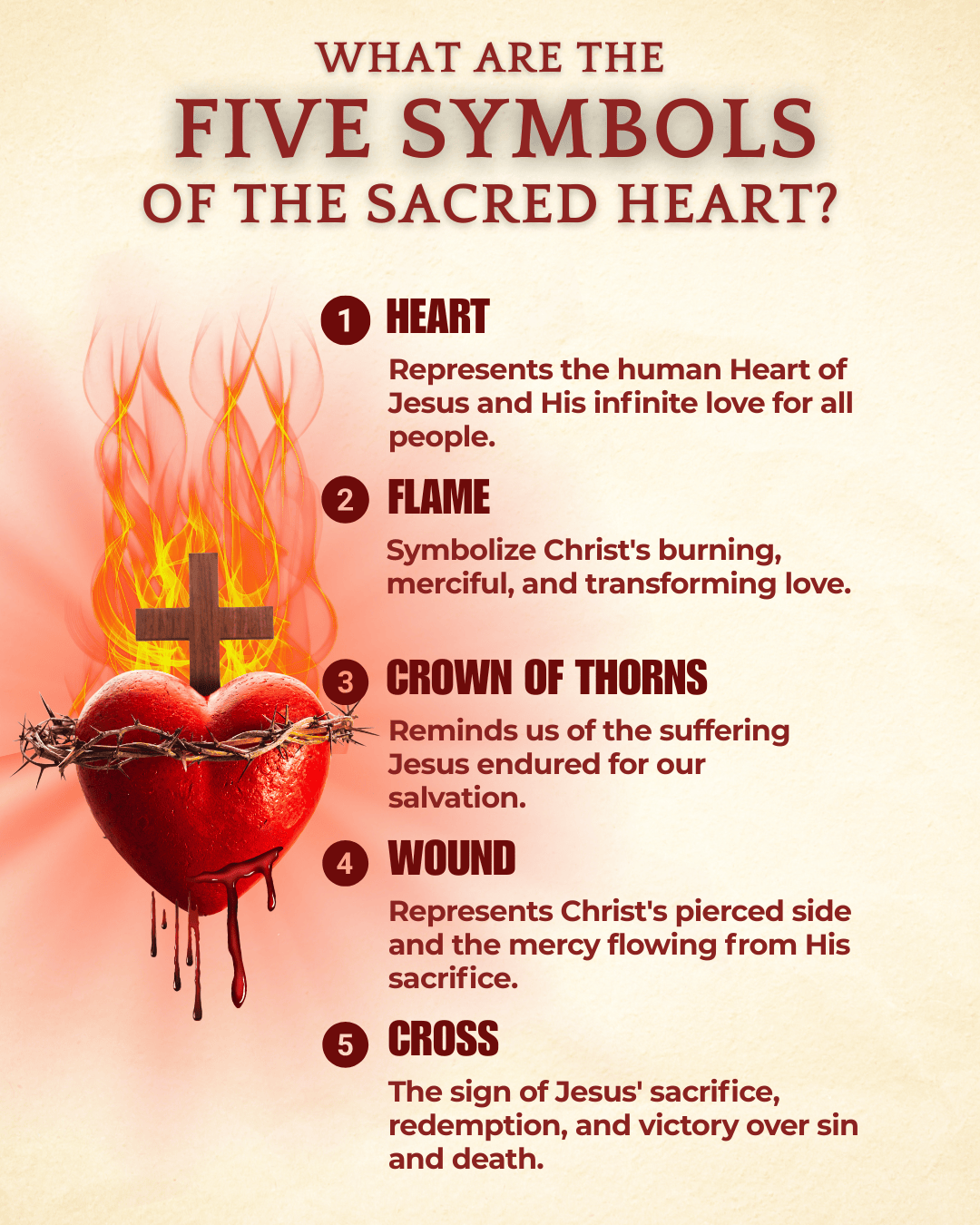
The five common symbols of the Sacred Heart are the heart, flames, crown of thorns, wound, and cross.
The Five Symbols of the Sacred Heart at a Glance
The five symbols of the Sacred Heart are usually understood as the heart, the flames, the crown of thorns, the wound, and the cross. Together, they tell the story of Christ’s love for humanity.
The heart points to the love of Jesus. The flames show that His love is burning, alive, and transforming. The crown of thorns reminds us of His suffering and the sins that wound His Heart. The wound points to His pierced side and the mercy that flows from His sacrifice. The cross shows that His love is sacrificial and victorious.
The Heart
The central symbol of Christ’s human and divine love for mankind.
The Flames
A sign of Christ’s burning, merciful, and transforming love.
The Crown of Thorns
A reminder of the suffering Jesus endured during His Passion.
The Wound
A sign of Christ’s pierced side, mercy, grace, and sacrificial love.
The Cross
A symbol of Jesus’ sacrifice, redemption, and victory over sin and death.
1. The Heart: Christ’s Love Made Visible
The heart is the central symbol of the Sacred Heart devotion. It represents the real human Heart of Jesus, but it also points beyond the physical organ to the depth of His love. Jesus is true God and true man. Because He became man, He loved us with a human heart while also loving us with divine love.
This matters because Christianity is not built on the idea of a distant God who watches human suffering from far away. In Jesus, God entered our world. He knew hunger, friendship, fatigue, sorrow, rejection, compassion, grief, and joy. His Heart was not untouched by human life. It was completely open, completely pure, and completely given.
When Catholics honor the Sacred Heart, they are honoring the love of Christ Himself. The visible heart helps us remember that Jesus did not love humanity in a vague or abstract way. He loved real people. He healed the sick, forgave sinners, welcomed the rejected, wept at the tomb of Lazarus, and gave Himself on the Cross.
The heart also reminds us that faith is not only about knowing facts about God. It is about entering into a relationship with Him. Jesus does not ask for cold obedience. He asks for our hearts. He invites us to trust Him, love Him, repent, and allow His mercy to transform us.
For many Catholics, the image of the Sacred Heart becomes a place of comfort and conversion. It reminds us that no wound, sin, grief, or fear is beyond the reach of Christ’s love. His Heart is not closed to the weak. It is open to the repentant, the weary, and the brokenhearted.
2. The Flames: The Burning Love of Jesus
The flames rising from the Sacred Heart symbolize the burning love of Jesus. This love is not passive, cold, or distant. It is alive, intense, merciful, and active. The fire reminds us that Christ’s love has the power to purify, warm, awaken, and transform the soul.
Fire is a rich biblical image. It can represent God’s presence, purification, zeal, and the work of the Holy Spirit. In the Sacred Heart, the flames help us see that Christ’s love is not weak sentiment. It is holy love, strong enough to endure the Cross and merciful enough to seek sinners.
This symbol is especially important because many people imagine love only as a feeling. The love of Jesus is much deeper than emotion. His love is faithful. It remains when we are unfaithful. It seeks us when we wander. It burns with mercy even when we have grown cold.
The flames also invite us to ask an honest question: Is my heart on fire with love for God, or has it become lukewarm? Devotion to the Sacred Heart is meant to awaken love in us. It calls us to pray more sincerely, receive the sacraments more faithfully, forgive more generously, and love others with greater patience.
The burning Heart of Jesus does not consume us in destruction. It purifies us in mercy. When we bring Him our sins, wounds, and fears, His love can begin to reorder what has become disordered and heal what has become hardened.
3. The Crown of Thorns: The Pain Caused by Sin
The crown of thorns surrounding the Sacred Heart points directly to the Passion of Jesus. Before His crucifixion, Jesus was mocked, beaten, and crowned with thorns. In images of the Sacred Heart, the thorns often encircle the heart itself, reminding us that Christ’s love was rejected and wounded by sin.
This symbol is not meant to make us despair. It is meant to help us understand the seriousness of sin and the depth of Christ’s mercy. Sin is not merely breaking a rule. Sin wounds love. It turns the heart away from God and damages our relationship with Him and with others.
The crown of thorns reminds us that Jesus chose to suffer for sinners. He did not love us only when we were easy to love. He loved us while bearing rejection, humiliation, cruelty, and pain. His Heart remained merciful even as He was wounded by the sins of the world.
This symbol also invites Catholics to make reparation. Reparation means responding to the wounded love of Christ with love, prayer, repentance, and acts of devotion. It does not mean that Christ’s sacrifice was incomplete. Rather, it means we choose to console His Heart by turning away from sin and loving Him more faithfully.
When we see the crown of thorns, we can ask ourselves where we have become indifferent to Jesus. Have we ignored His love? Have we delayed repentance? Have we treated sin lightly? The thorns invite us not to fear His Heart, but to return to it with humility.
4. The Wound: Mercy Flowing From the Pierced Side of Christ
The wound in the Sacred Heart recalls the moment when a soldier pierced the side of Jesus after His death on the Cross. From His side flowed blood and water. Catholics have long seen deep meaning in this moment, especially as a sign of Christ’s mercy, the life of the Church, and the grace that flows from His sacrifice.
The wound reminds us that Jesus held nothing back. His love was not partial. He gave His whole life for us. Even after death, His pierced side revealed the generosity of His Heart. The wound is a sign of suffering, but it is also a sign of mercy opened for the world.
In Catholic reflection, the blood and water have often been connected to the sacraments, especially the Eucharist and Baptism. Through Christ’s sacrifice, the Church receives life. Through His wounded Heart, sinners are invited into forgiveness, cleansing, and communion with God.
This symbol can be deeply comforting for those who feel ashamed, burdened, or far from God. The wound in the Heart of Jesus does not say, “Stay away.” It says, “Come to Me.” It shows that mercy has been opened. The pierced Heart of Christ is not closed against sinners. It is open for their salvation.
The wound also teaches us something about Christian love. Real love is willing to be poured out. It does not always avoid sacrifice. Parents, spouses, friends, caregivers, and those who serve others understand this in ordinary ways. The wounded Heart of Jesus shows the perfect form of self-giving love.
5. The Cross: Sacrifice and Victory
The cross above the Sacred Heart reminds us that Christ’s love is inseparable from His sacrifice. Jesus did not save the world through comfort or popularity. He saved us through His Passion, death, and Resurrection.
In many images, the cross rises from the flames of the heart. This shows that the love of Jesus is crucified love. His love does not run from suffering when suffering is required for our salvation. He willingly gives Himself to the Father for us.
The cross is also a sign of victory. To the world, the Cross looked like defeat. To the eyes of faith, it is the place where Christ conquered sin and death. The Sacred Heart crowned by the cross reminds us that love has triumphed through sacrifice.
This is important for Catholics because we often want a faith without crosses. We want peace without surrender, holiness without conversion, and love without sacrifice. The Sacred Heart teaches us that true love is willing to give. The cross does not destroy love. In Christ, the cross reveals love most clearly.
When we face suffering, the cross above the Sacred Heart reminds us that Jesus is not absent. He knows suffering from the inside. He can give meaning, strength, and grace in moments we do not understand. His Heart remains close to those who carry heavy burdens.
How These Symbols Deepen Sacred Heart Devotion
The five symbols of the Sacred Heart are not meant to be studied only as artwork. They are meant to lead us into prayer. Each symbol invites a response from the heart.
The heart invites us to trust the love of Jesus. The flames invite us to ask for renewed zeal and conversion. The crown of thorns invites us to repent and make reparation. The wound invites us to receive mercy. The cross invites us to unite our sacrifices with Christ.
This is why Sacred Heart devotion is so practical. It speaks to the whole Christian life. It helps us pray when we are tired, repent when we have sinned, trust when we are afraid, and love when love is difficult.
Catholics often practice devotion to the Sacred Heart through First Friday devotion, Eucharistic Adoration, the Litany of the Sacred Heart, consecration to the Sacred Heart, family enthronement, and simple daily prayer. These practices are not meant to replace the sacraments. They are meant to lead us more deeply into the life of Christ and the Church.
A simple way to pray with the Sacred Heart is to look at each symbol slowly. Begin with the heart and thank Jesus for His love. Look at the flames and ask Him to set your heart on fire with faith. Look at the thorns and ask forgiveness for sin. Look at the wound and receive His mercy. Look at the cross and ask for strength to carry your own crosses with trust.
Look at the Heart
Thank Jesus for loving you personally and ask Him to make your heart more like His.
Pray with the Flames and Thorns
Ask for a renewed love for God and a sincere sorrow for the sins that wound Christ’s Heart.
Rest in the Wound and Cross
Receive Christ’s mercy and ask for grace to carry your own crosses with faith, patience, and love.
A Simple Prayer to the Sacred Heart of Jesus
Prayer to the Sacred Heart
Sacred Heart of Jesus, burning with love for me, draw my heart closer to Yours. Help me trust Your mercy, repent of my sins, and love You more faithfully. May Your wounded Heart heal what is broken in me, and may Your Cross teach me to love with patience, courage, and sacrifice. Sacred Heart of Jesus, I place all my trust in You. Amen.
This prayer can be said in the morning, before an image of the Sacred Heart, during Eucharistic Adoration, or anytime you need to remember Christ’s love. The words do not need to be complicated. The important thing is to come to Jesus honestly and allow His Heart to shape yours.
Frequently Asked Questions About the Five Symbols of the Sacred Heart
What are the five symbols of the Sacred Heart?
The five common symbols of the Sacred Heart of Jesus are the heart, the flames, the crown of thorns, the wound, and the cross.
What does the heart symbolize?
The heart symbolizes the real human Heart of Jesus and His divine love for the Father and for all humanity.
What do the flames mean?
The flames symbolize the burning, living, merciful, and transforming love of Christ.
Why is there a crown of thorns around the Sacred Heart?
The crown of thorns represents the suffering Jesus endured during His Passion and the pain caused by sin, rejection, and indifference.
What does the wound in the Sacred Heart mean?
The wound recalls the pierced side of Christ, from which blood and water flowed. It symbolizes mercy, grace, and Christ’s total self-giving love.
What does the cross above the Sacred Heart mean?
The cross represents Christ’s sacrifice, redemption, and victory over sin and death.
How can Catholics pray with the symbols of the Sacred Heart?
Catholics can meditate on each symbol by thanking Jesus for His love, asking for renewed faith, repenting of sin, receiving His mercy, and uniting their sufferings with His Cross.
Let the Sacred Heart Lead You Deeper Into the Love of Jesus
The five symbols of the Sacred Heart remind Catholics that Christ’s love is real, burning, wounded, merciful, sacrificial, and victorious. May the Heart of Jesus help you trust His mercy, turn away from sin, and love Him more faithfully each day.
Explore Catholic Prayers